Empty Exhibit Cases
Writing project (2021/2022)
with Maribel Mendes Sobreira & Susana Gaudêncio
for maat ext.
![]() © Smithsonian Institution Archives. Image # MAH-4489.
© Smithsonian Institution Archives. Image # MAH-4489.
Empty Exhibit Cases with Maribel Mendes Sobreira & Susana Gaudêncio
for maat ext.
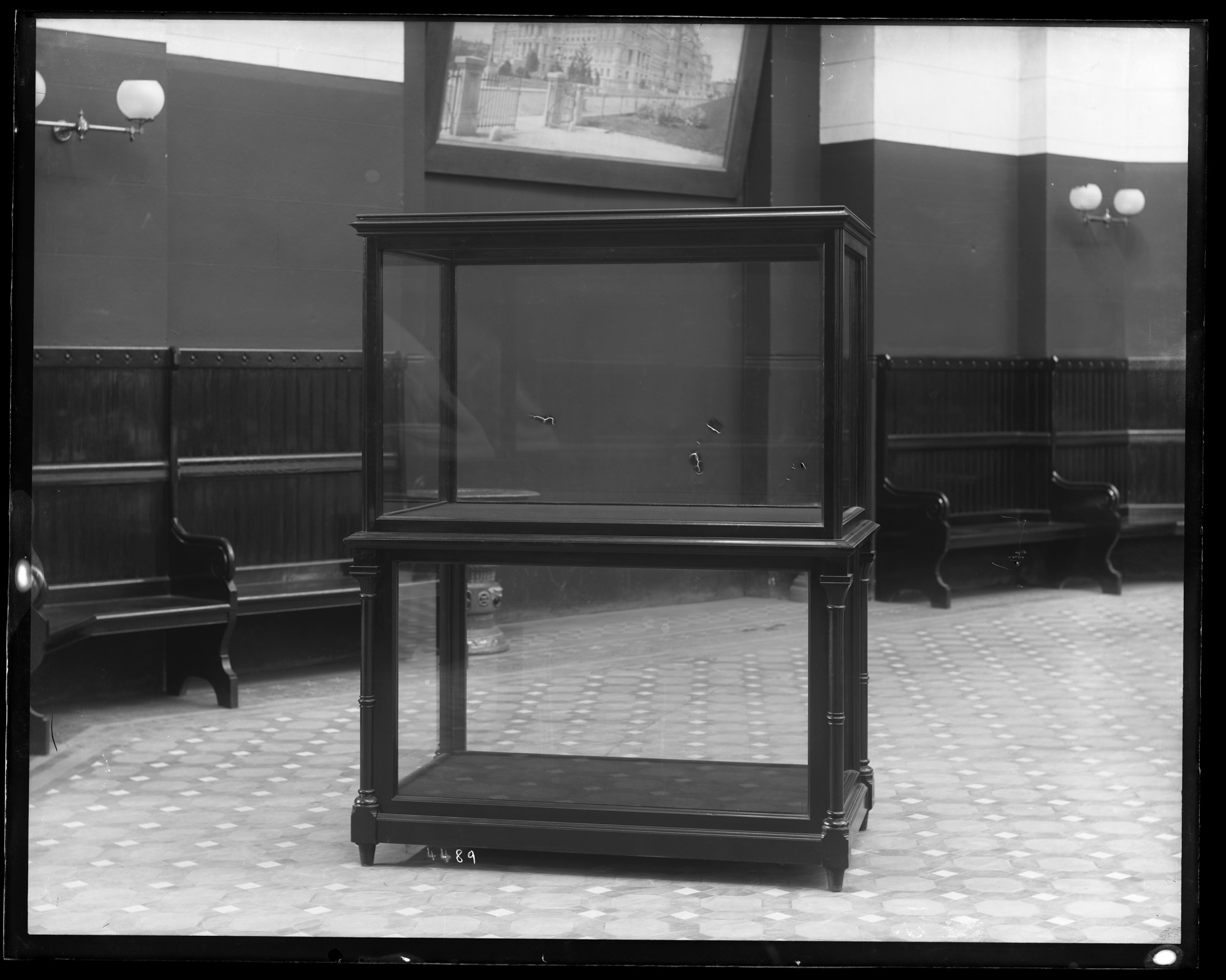 © Smithsonian Institution Archives. Image # MAH-4489.
En route to becoming an ally in the arts. Join us any time.
This project gathers three cisgender white women working in the arts, Susana Pomba, Susana Gaudêncio and Maribel Mendes Sobreira, on their way to become lifelong anti-racist and effective allies, as artists, teachers, researchers, curators, historians, writers, or authors.
Where we think we stand, what we believe our opinions to be are at times just an affirmation or an assertive automatic reply to a generic question. Some of our beliefs need to be challenged, attuned, improved, and reinstated. Some of our beliefs need to be translated into our daily practice, as actions and decisions.
The struggles of white women in the arts for gender equality should always be intertwined with issues and studies of race, especially when it comes to understanding the injustices faced by women of colour. It is our responsibility to dissect our white privilege. As women, we are not culturally dominant (we still fight for equality), but we are privileged as white, which we should recognise in order to turn ourselves into allies for change.
So, how do we do the work and where do we position ourselves? What is the syllabus? What are the stages? How do we put words into action? How do we salute the past, recognise its errors, and move forward with agility into the future of our communities, making them more diverse, open, and groundbreaking in nature? How do we expand our world and question our parameters for taste? In these intersectional struggles, what is our course of action, which roads do we take for a fairer, inclusive, representative, and diverse art world?
Empty Exhibit Cases, will produce a group of essays (in diary mode), that might be hybrid in form, and – going back to the original definition of the word essay, the French word essayer – attempt to dissect these questions and struggles, all in the context of the daily personal and professional lives of the three participants. They will also engage in conversation with activist groups, scholars, or cultural agents.
With an image of an empty exhibit case, we speculate, we project — are they empty because historical artefacts belonging to other countries have finally returned to their rightful owners? We desire justice and truth. Are they empty because they are waiting for the contemporary art works and artists that have been overlooked, minimised, forced into disappearance? We shall turn this symbolism into a practical and literal opening of space to show work we have unfairly disregarded before, this way enlarging our aesthetic grounds, instilling real diversity, and quite simply learning, exhibiting, educating, preserving, reflecting and taking care of (curating). Every and any time, here we are, dive in.
Susana Pomba
Empty Exhibit Cases
Empty Exhibit Cases [can you jot that down?]
“Are you going to protect me?” a conversation with Maria Vlachou
“A kind of mesh”, a conversation with Teresa Fradique
“A horizontal presence, as much as possible”, a conversation with Ana Balona de Oliveira
“Questioning the Question” An essay by Maribel Mendes Sobreira
Public Journal Entry [Wa-Wa-Walking] An essay in three parts by Susana Pomba
“Notes on Privilege, Bodies, Statues and the Public Sphere” Essay and drawings by Susana Gaudêncio
“Seeing is Subject. Unlearn the System” An essay by Maribel Mendes Sobreira

© Smithsonian Institution Archives. Image # MAH-24053
 © Smithsonian Institution Archives. Image #
75-11093-16A
© Smithsonian Institution Archives. Image #
75-11093-16AnEsting, the work of helena lapas
“(…) A piece of thread ripped-out from a fierce design,

some weaving figured as magic against oppression. (…)”
Adrienne Rich, in Collected Poems: 1950-2012
Entry: Head Over Textiles
“Textile Factory Worker, England” (1943) is the title of a Lee Miller photograph which presents a woman’s head on top of a significant pile of fabric. She is looking not at the camera but to the side, to a room (interior and exterior at the same time) adorned on top by what seems to be bunches of onions. The way the picture is framed shows Miller’s surrealistic edge, as we can’t really see what or who is holding so much fabric, creating the illusion of a detached head on top of a heap of cloth. Obviously, by choosing to describe it, I am stating that this image is a good segue into Helena Lapas’ work, which involves an important idea of intense labour within the world of fabrics (or fibre, if you want to use a wider umbrella term), their prevalence in our world (we use them every day to cover ourselves), and also a connection to the way small pieces of “something” (fabric, fibre, paper) can develop in the artist’s hands into elaborated works that seem dark, delicate, heavy and otherworldly, all at the same time. Lapas makes dense and detailed tapestries and fibre sculptures inspired by found forms that she carefully selects and chooses to bring into her “factory”, which is to say, her home-studio (or studio-home). But then, what we see as audience, when trying to grasp her level of detail, is the product of weeks and weeks of action and rest, of layers and layers of glue on top of artisanal paper, of “painting” with tiny fibre extracts that get turned into something else altogether that doesn’t resemble the fragment that was in some way used as a start. But strangely, these pieces still seem to belong to a larger family of nature, in their shape and in their surface, that are never simple or opaque but always textured, detailed, complicated, as tough and elaborate as snake skin.
Surviving Your Surroundings
Born in 1940, Helena Lapas witnessed the majority of the Portuguese dictatorship, Salazar’s New Estate (1933-1974). The roots of her choice of medium of expression come from the fact that she was surrounded by fabric from an early age —her mother was a dressmaker. In a rural and poor Portugal, art academies were few and slow to develop and mainly taken over by men. After a good experience at António Arroio, a high school devoted to the arts, an oasis in Lisbon, the painting degree at the Lisbon fine-art school was oppressive for a woman who had already chosen her medium—what we now call fibre arts. She did not want to use paint on canvas but thread, fabric and other fibres, in an almost abstract world-weaving, defying what was considered craft iconography and painting at the same time. In the end, a stroke of luck allowed Lapas to present a tapestry for her final evaluation, setting a precedent (at the end of the 1960s) for those who followed. I suspect the fine art school had a problem with most fabric on the wall, by women, even if it was stretched canvas (as we know, also fabric). This was the end of the 1960s and start of the 1970s, the exact time that other women artists around the world were using fabric and weaving in their art works, either as their main medium or as part of an array of different ones, while trying to express different narratives, approaches, and themes connected with their experience, in contemporary art’s male-dominated environment. It was a hard task, the word “domestic” or “craft” carried negative connotations given by patriarchy, in order to erase and restrain women’s capacities and areas of activity, and overall attempts at being artists. It took many decades to solidify and inscribe Anni Albers expert geometric abstraction weaving; Howardena Pindell’s textured abstraction made with paper circles and by cutting and sowing the canvas; Louise Bourgeois’ fabric works; or Lee Bontecou’s tridimensional wall works made of steel and canvas. I could go on and mention other important names as Sheila Hicks or Cecilia Vicuña, whose work has been given more attention in recent times. But there is still a lot to be studied about this medium, hence the recent survey shows, “Woven Histories. Textiles and Modern Abstraction” (2025) at the MOMA, or “Unravel: The Power and Politics of Textiles in Art” (2024), at the Barbican.

© Bruno Lopes / Monitor Gallery
Interior Nesting
If the world is hostile, in order to survive your exterior surroundings, some women artist’s homes must not just become their refuge but their realm. It is there they express themselves fully and away from judgment. Lapas has a certain reluctance in being away from her home and her work, and most importantly, she is also a maker of homes and spaces—certain special people are just better at gathering, choosing, bringing into their private space things that tie each room of the home together, sowing a harmony that is so personal and so intricate that any one welcomed into it feels as if they are stepping into the owner’s weaves. A different land. Only a small part of this can be called décor, most of it is the workings of an exceptional creative mind, the rules followed have nothing to do with commercial fashions, it is the logic of a true artist far from any societal trend. Over the decades, Lapas has built her studio-homes in Lisbon and from the 1960s until 2020 also in Ericeira, a coastal village near the capital, known for its beaches, delicacies and charm. Helena Lapas and David Evans, her husband since the 1960s and fellow creative mind, researcher and teacher, spend most of the time in their small homes, filled with their treasures, figuring out where things fit, where they can be stored, a contingency of small Portuguese homes but also a puzzle of life being rearranged continuously as more pieces get produced and delicately solved. Their home is filled with books (paper), furniture (wood) that fits the space tightly, textures (fabric) that seem to cover almost every inch of wall space, also pillows or curtains, in general things that envelop you when you’re there. You are happily lost, in such a small space. Helena Lapas’ sculptures (finished and unfinished) temporarily occupy, in turn, the many tables as if paused thoughts, and they might be replaced by a plate with a meal, and then back again. It’s not that the home looks like a studio but that the studio has all the functions and related objects required to be a welcoming, full-functioning home. Or maybe the other way around. Let’s just say that all types of objects and images—belonging to both realms, home and studio—get rearranged and relocated in the space in a constant loop of necessity. In a constant circle of activity. Whether someone is cooking, sowing, gluing.

© Bruno Lopes / Monitor Gallery
Exterior Nesting
The artist might eventually venture out of the home but only to fetch food and bring pieces of nature, new starts. She might even be inside her own home but have an opening to the exterior, a small back garden, where more observation happens and more things are found. In Ericeira, a place of long-lasting influences and community, the artist’s home was very small, but had a balcony on top of the sea, infinite—there was nothing between them and the ocean. Lapas and Evans still spend time in a similar (interior and exterior) space in Ericeira, every year. It is that gaze upon shapes, colours, textures, images, and objects and their uses, dictated by partly human, but mostly non-human environments that Lapas takes on, letting her choices be ruled intuitively by those elements. Lapas’ sculptures seem to reference things that are heavy (literally or figuratively)—we can grasp it in her titles—they can be stones, masks, shields, shells, shrines, lost wings, hornet's nests, the skin or bones of snakes, or fish. A whole map of the coating of the volume of nature that is reinterpreted into a new being/piece. There is extreme respect for materials and how they live within a piece, and how they can be bent to accommodate the next shape or texture. The same way a bird takes each small branch to weave a nest with its beak, even if Lapas, in the end, is making an exaltation of nature in an artwork. The relationship between women and nature has not been an easy one. Specially because of the engrained imposed patriarchal structure that speaks of “mother-nature” and relates all things maternal, to women only, constraining them and using this connection to withdraw them from other circles and universes. This history is being rewritten, in part through the eyes of women artists, as it should. There is an otherworldly quality to the thick, engrained, organic compositions that Lapas builds. The magic worlds of her sculptures and tapestries seem to share something with the women artists of the surrealist movement, and how differently they wove and approached their imagination, with a desire to “search for correspondences between the unconscious and the natural world”1. If I started by quoting a Lee Miller photograph, I’ll end with an artist of the same period, Eileen Agar who wrote about her practice as a “very private occupation, I hardly like to talk about it, it is something that germinates like a seed, in the dark soil and recesses of the living coral of the mind… They [paintings] grow like a plant, slowly putting out shoots, they need pruning, meditation on, while the roots grow in the dark.”2
Susana Pomba, January 2026
1 Chadwick, Whitney. Women Artists and the Surrealist Movement. London: Thames & Hudson, 1985 and 2011, p.196.
2 Ibidem, p.210.
PT
NESTING, O TRABALHO DE HELENA LAPAS
“(…) A piece of thread ripped-out from a fierce design,
some weaving figured as magic against oppression. (…)”
Adrienne Rich, in Collected Poems: 1950-2012
Início: Cabeça sobre Têxteis
“Trabalhadora de Fábrica de Têxteis, Inglaterra” (1943) é o título de uma fotografia de Lee Miller em que vemos uma cabeça de uma mulher sobre uma pilha significativa de tecido. Ela não está a olhar para a câmara, mas para o lado, para uma sala (interior e exterior ao mesmo tempo) adornada no topo com o que parecem ser réstias de cebolas. O enquadramento da imagem mostra a vertente surrealista de Miller, já que não conseguimos ver o quê ou quem está a segurar em tanto tecido, criando a ilusão de uma cabeça solta em cima de uma pilha de material. Obviamente, ao escolher descrevê-la, estou a mostrar que acredito que esta imagem é um bom início para pensar o trabalho de Helena Lapas, já que envolve uma ideia importante de trabalho intenso no mundo dos tecidos (ou fibre art, se quisermos usar um termo mais abrangente), a sua importância no nosso mundo (usamo-los todos os dias para nos cobrir) e também uma ligação à forma como nas mãos da artista pequenos pedaços de “algo” (tecido, fibra, papel) podem tornar-se obras elaboradas que parecem sombrias, delicadas, pesadas e sobrenaturais, tudo ao mesmo tempo. Lapas cria tapeçarias densas e detalhadas, e esculturas em fibra inspiradas em formas que encontra, seleciona com cuidado, e escolhe levar para a sua “fábrica”, ou seja, a sua casa-atelier (ou atelier-casa). O que vemos como público, ao tentar compreender o nível de detalhe, é o produto de semanas e semanas de ação e descanso, de camadas e camadas de cola sobre papel artesanal, de “pintura” com pequenos extratos de fibras que se transformam em algo completamente diferente, que não se assemelha ao fragmento que foi, de alguma forma, usado como ponto de partida. Mas, estranhamente, estas peças ainda parecem pertencer a uma família maior da natureza, na sua forma e na sua superfície, que nunca são simples ou opacas, mas sempre cheias de textura, detalhe, enredo, e tão resistentes e elaboradas como a pele de uma cobra.
Sobreviver ao ambiente que nos rodeia
Nascida em 1940, Helena Lapas testemunhou a maior parte da ditadura portuguesa, o Estado Novo de Salazar (1933-1974). A sua escolha de suporte artístico tem origem no facto de estar rodeada por tecidos desde tenra idade – a sua mãe era costureira. Num Portugal rural e pobre, as academias de arte eram poucas, lentas a desenvolver-se e dominadas na maioria por homens. Após uma boa experiência na António Arroio, liceu dedicado às artes, o curso de Pintura nas Belas-Artes de Lisboa foi opressivo para alguém que já tinha escolhido o seu meio de expressão – o que hoje chamamos fibre art. Lapas não queria usar tinta sobre tela, mas sim fios, tecidos e outras fibras, num mundo quase abstrato e urdido, desafiando ao mesmo tempo o que era considerado artesanato ou pintura. No final, um golpe de sorte permitiu a Lapas apresentar uma tapeçaria na sua avaliação final, estabelecendo um precedente (no final da década de 1960) para aqueles que se seguiram. Suspeito que a faculdade de Belas-Artes tinha um problema com a maioria dos tecidos na parede, em especial os que fossem feitos por mulheres, mesmo que fossem em tela esticada (a tela é tecido, como sabemos). Era o final da década de 1960 e o início da década de 1970, e ao mesmo tempo outras mulheres artistas noutras partes do mundo usavam tecidos e tecelagem nas suas obras de arte, seja um de vários suportes, ou o principal, enquanto tentavam expressar diferentes narrativas, abordagens e temas relacionados com a sua experiência, no meio da arte contemporânea, um ambiente dominado por homens. Foi uma tarefa difícil, pois as palavras “doméstico” ou “artesanato” carregam conotações negativas atribuídas pelo patriarcado, com o objetivo de apagar e restringir as capacidades e áreas de atividade das mulheres e, em geral, as suas tentativas de serem artistas. Foram necessárias muitas décadas para consolidar e inscrever a abstração geométrica em tecelagem de Anni Albers; a abstração impregnada de textura de Howardena Pindell feita com círculos de papel, cuja superfície é cortada e costurada; os trabalhos em tecido de Louise Bourgeois; ou as obras tridimensionais de parede de Lee Bontecou feitas de aço e tela. Podia mencionar outros nomes importantes como Sheila Hicks ou Cecilia Vicuña, cujo trabalho tem recebido mais atenção nos últimos tempos. Mas ainda há muito a ser estudado sobre este suporte, como mostram as recentes exposições “Woven Histories. Textiles and Modern Abstraction” (2025) no MOMA, ou “Unravel: The Power and Politics of Textiles in Art” (2024), no Barbican.
Ninho Interior
Se o mundo é hostil, para sobreviver ao ambiente exterior, as casas de algumas mulheres artistas não devem ser apenas o seu refúgio, mas o seu domínio. É lá que as artistas se expressam de forma plena, longe de julgamentos. Lapas tem uma certa relutância em se afastar da sua casa e do seu trabalho, e é importante referir que esta artista e também uma criadora de casas e espaços – algumas pessoas especiais são sem dúvida melhores a reunir, escolher e trazer para o seu espaço privado objetos que completam cada divisão, semeando uma harmonia tão pessoal e tão intricada que seja quem for que seja convidado, sente-se a entrar no enredo da artista. É uma terra diferente. Só uma pequena parte pode ser chamada de décor, a maior parte é o trabalho de uma mente criativa excecional, e as regras seguidas nada têm a ver com modas comerciais e efémeras, a lógica é a (mesma) da artista, que está longe de qualquer tendência. Ao longo das décadas, Lapas construiu o seu atelier-casa em Lisboa e, desde os anos 1960 até 2020, também na Ericeira, uma vila costeira perto da capital, conhecida pelas suas praias, iguarias e charme. Helena Lapas e David Evans, seu marido desde os anos 1960 e também mente criativa, para além de investigador e professor, passam a maior parte do tempo nas suas pequenas casas, repletas dos seus tesouros, a decidir onde as coisas se encaixam, onde podem ser guardadas, uma contingência das pequenas casas portuguesas, mas também um puzzle de vida que é de forma contínua reorganizado à medida que mais peças são produzidas e resolvidas de forma delicada. A casa deles está repleta de livros (papel), móveis (madeira) que se encaixam à medida no espaço, texturas (tecido) que parecem quase cobrir cada centímetro das paredes, além de almofadas ou cortinas, em geral coisas que envolvem quem lá se encontra. É fácil perdermo-nos, num espaço tão pequeno. As esculturas de Helena Lapas (concluídas e inacabadas) ocupam de forma temporária, à vez, as muitas mesas como se fossem pensamentos em pausa, e podem ser substituídas por um prato com comida e a seguir, regressar à mesa. Não é que a casa pareça um estúdio, mas que o estúdio tem todas as funções e objetos necessários para ser uma casa acolhedora e totalmente funcional. Ou talvez o contrário. Digamos apenas que todos os tipos de objetos e imagens – pertencentes a ambos os territórios, casa e estúdio – são reorganizados e realocados no espaço num ciclo constante de necessidade. Num ciclo constante de atividade. Seja o que for que alguém esteja a fazer: a cozinhar, a costurar, a colar.
Ninho Exterior
A artista pode por vezes aventurar-se para fora de casa, mas apenas para ir comprar comida e trazer pedaços de natureza, novos começos. A artista até pode estar dentro da sua própria casa, mas ter uma abertura para o exterior, um pequeno jardim nas traseiras, onde ocorre mais observação e onde mais coisas são encontradas. Na Ericeira, um lugar de influências duradouras e comunidade, a casa da artista era muito pequena, mas tinha uma varanda quase no mar, infinita — não havia nada entre eles e o oceano. Lapas e Evans ainda passam tempo num espaço semelhante (interior e exterior) na Ericeira, todos os anos. É esse olhar sobre formas, cores, texturas, imagens e objetos e seus usos, ditado por ambientes em parte humanos, mas na maioria não-humanos, que Lapas agarra, deixando a sua intuição ser regida por esses elementos. As suas esculturas parecem fazer referência a coisas pesadas (de forma literal ou figurativa) – conseguimos percebê-lo nos seus títulos – podem ser pedras, máscaras, escudos, conchas, santuários, asas perdidas, ninhos de vespas, pele ou ossos de cobras ou peixes. Um mapa completo do que cobre o volume da natureza que é reinterpretado numa nova forma/peça. Há um respeito extremo pelos materiais e pela forma como eles vivem na obra, e como podem ser moldados para acomodar a próxima forma ou textura. Da mesma forma que um pássaro transporta cada pequeno galho para tecer um ninho com o seu bico, mesmo que Lapas, ao fim ao cabo, esteja a fazer uma exaltação da natureza nas suas obras. A relação entre as mulheres e a natureza não tem sido fácil. Em especial, por causa da estrutura patriarcal imposta e enraizada que fala da “mãe natureza” e relaciona todas as coisas maternas apenas às mulheres, restringindo-as e usando essa ligação para afastá-las de outros círculos e universos. Esta história está a ser reescrita, em parte através dos olhos de mulheres artistas, como deve ser. Há uma qualidade sobrenatural nas composições densas, enraizadas e orgânicas que Lapas constrói. Os mundos mágicos das suas esculturas e tapeçarias parecem partilhar algo com as mulheres artistas do movimento surrealista e com a forma diferente como elas teciam e abordavam a sua imaginação, com o desejo de “procurar correspondências entre o inconsciente e o mundo natural”¹. Se comecei por citar uma fotografia de Lee Miller, terminarei com uma artista do mesmo período, Eileen Agar, que escreveu sobre a sua prática como uma “ocupação muito privada, é raro gostar de falar sobre ela, é algo que germina como uma semente, no solo escuro e nos recantos do coral vivo da mente... Elas [as pinturas] crescem como uma planta, brotando devagar, precisam de poda, que meditem, enquanto as raízes crescem na escuridão.”²
Susana Pomba, Janeiro 2026
1 Chadwick, Whitney. Women Artists and the Surrealist Movement. London: Thames & Hudson, 1985 e 2011, p.196. Tradução da autora.
2 Ibidem, p.210.
“Trabalho de Gaja” [Broad’s work]
and the title must contain inverted commas
[text comissioned by the curator Ana Anacleto
and the artist Alice Geirinhas for the catalogue
of the exhibition “Existem pedras nos olhos”)
![]()
Instructions, Alice Geirinhas and Susana Mendes Silva, 2018 © Bruno Lopes
When asked, ‘What sparked your interest in talking about the body?’, in reference to work produced during the 1960s, the poet Maria Tereza Horta replied, ‘I began to see that in the books that I read, it was men who talked about the body. In other words, men had bodies, women practically didn't.’1, back then it was effectively ‘forbidden’2 to talk, and write, about women's bodies. I stand here writing to you, born in 1974, and I clearly remember this interdiction: women's bodies were to be kept hidden, in a mixture of oppressive puritanical views, which were political and religious. The title of Alice Geirinhas' exhibition, There are stones in our eyes, is taken from one of Horta’s poems, because the connections and courage of the Three Marias, like so many women in the feminist movements that began in the 1970s, continue to be important, and still need to be talked about today. One of the most distinctive characteristics of Geirinhas' creative action, that involves the viewer — whether they’re female, male or non-binary — is the feeling of sisterhood, which she clearly demonstrates, while always recognising her predecessors: the great women of comic books, feminist art, contemporary art, international and Portuguese art (her female colleagues, whether or not from her generation). And whoever comes after them, through a continuous demonstration of the importance of remembering injustices in order to conquer and uphold human rights, the importance of occupying space, and respecting people who are even more silenced and discriminated against, such as black women artists. This discussion is still very recent in Portugal. There is a proliferation of a stifling gatekeeping in the world of contemporary art that has devastating consequences for the work of women artists. It's almost as if I can hear someone say, ‘Oh, it's so much better today’, and if partially we have gained so much from the struggles of the 1970s, the fight isn’t over and it’s incredibly necessary to not pretend it is. I'm going to tell you a short story that happened to me in 2021. Which I know isn’t an ‘isolated act’.and the artist Alice Geirinhas for the catalogue
of the exhibition “Existem pedras nos olhos”)

Instructions, Alice Geirinhas and Susana Mendes Silva, 2018 © Bruno Lopes

Lisístrata, Alice Geirinhas, 2022-on going © Bruno Lopes
I didn't quite get it, at first. My capacities, mental or other, must be diminished. The sentence before this one began with a negation. I remember hearing somewhere that a negation can dissuade someone from continuing to read. It's very ‘negative’. I presume that this must be a concept from advertising or marketing. I'm glad I began this paragraph with irony.
Let us set the scene: a man, white, working in the arts; a curator, woman, white; the context is a Portuguese one. I'm not going to reveal his profession or where in Portugal the conversation took place. Let's simply call him ‘G’, because it marks the spot. The curator, woman, white, is me, the author of this text. Let's imagine we have a cordial, professional relationship (without ever working together) which remained very superficial over the years. ‘What are you up to?’ — he asked me. I replied with honesty and in a straightforward manner, with something like ‘I'm preparing a database of Portuguese women artists’. What followed was information that I didn’t request. Nor did I request the proximity with which he chose to talk and the very expressive way he proclaimed the words: ‘If there's one thing I can’t stand it's broad’s work. He repeated, ‘I hate broad’s work’. What does ‘broad’s work’ really mean? I wondered.
Is it Artemisia Gentileschi portraying herself as Catherine of Alexandria? Is it Vanessa Bell painting a portrait of her sister, Virginia? Is it Augusta Savage teaching her students in Harlem? Is it Hilma af Klint stating that her paintings would only be revealed 20 years after her death? Is it Yoko Ono sitting on the floor while strangers cut off her clothes with a pair of scissors? Is it Chantal Akerman locked in the kitchen washing the floor or shining her shoes? Is it Delphine Seyrig making the bed, peeling potatoes and welcoming men into her home? Is it the production team of Agnès Varda's Ciné-Tamaris working in the street, on top of sand? Is it Claude Cahun producing a self-portrait? Is it Faith Ringgold cutting the letters for ‘Woman Freedom Now’? Is it Mierle Laderman Ukeles washing the museum’s stairs on her knees? Is it Agnes Denes planting seeds of wheat near the World Trade Center? Is it Howardena Pindell peeling off white "skin" from her face? Is it Ana Mendieta photographing herself, bent over a table, with her knickers round her ankles, and blood all over her legs? Is it Lynda Benglis in the ad she paid for, published in Art Forum? Is it Adrian Piper wearing a wig, moustache, and glasses, wandering around the city? Is it Barbara Kruger placing the sentence ‘Your body is a battleground’ on a photograph of a woman's face? Is it Maria Auxiliadora da Silva composing the painting Three Women? Is it Jenny Holzer inscribing the phrase ‘Raise Boys and Girls the Same Way’ on a marquee? Is it Sarah Lucas with two fried eggs on her T-shirt, covering her breasts? Is it Gretta Sarfaty dressed in white, performing A Maga in the middle of the street? Is it Clara Menéres watering her grass sculpture? Is it Júlia Ventura photographing herself on the beach, wrapped in a big red piece of cloth? Is it Judy Chicago making sculpture-plates that represent women's vulvas, so that a woman’s place at the table won’t be forgotten? Is it Lourdes Castro placing a vase with flowers in the middle of a sheet of paper and drawing the shadows of the leaves? Is it Rosa Fazenda's Nun lifting up her skirt? Is it Ana Vieira outlining the rooms in a house and saying what is on her mind? Is it Paula Rego drawing a woman undergoing an illegal abortion, with her legs propped up on chairs? Is it Susana Mendes Silva painting an OB tampon gold? Is it Alice Geirinhas drawing the female genitalia of a female dog, sow, cow and mare?
Wait, was it ‘broad’s work’ when Vito Acconci offered ‘two hours with a woman’ (and two women ‘to choose from’) to anyone who could (literally) outjump him, based on marks on a piece of wood in the exhibition space?3 Can we assume that he thought only a man could outjump him? Or is this the work of a pimp? Nancy Princenthal reports that in Acconci's notes, he only talks about his possible defeat, since he might not outjump everyone else, and also be defeated because the prize was two women that he was close to and said he was in love with. But as Princenthal notes, he made no reference to the women in question, and their experience in the midst of this work, only that he had trouble convincing them, and making sure that they didn't give up.4

Broad Jump, Vito Acconci, 1971
A tear of anger almost rolled down G's face (I'm exaggerating). He almost stomped his foot, as he said, ‘I hate broad’s work’. I witnessed what the writer Eimear McBride termed ‘disgust’ in relation to women. Wondering where this sensation came from, she describes it as "the disgust that appears to mystically attach itself to the female body at birth — although sometimes too upon the mere determination of sex in the womb — and then proceeds to pursue that body right through each stage of its being, especially the later ones though, it should be said."5 For McBride, this disgust is expressed on a large scale and without thought, ‘Sometimes viciously and particularly. Economically and politically. Culturally and religiously. But always damagingly, and consequentially.’6
G revealed further layers and layers of incomprehension when he pointed to a work of art that contained a representation of a nude male body (Greek-like, as they say). There are some things that are so eloquent they take longer to process.
It was only afterwards that I (finally!) realised that what he was pointing at, without uttering a word, just a few grunts, was a representation of the male sexual organ. It was a realistic representation of what we might call the normative naked white male body (I here summon Kenneth Clark, I’m sorry, Baron Kenneth Clark OM CH KCB FBA7, and what is colloquially referred to as an ‘artistic nude’).
And why not, let’s make an amusing aside and confabulation: the naked man depicted in this work of art, as it happens, wasn't taking a pee. The French art historian Jean-Claude Lebensztejn astutely remarks: ‘Not just anyone makes a good pisser’8 and also that ‘(...) these pissing youths are and must be male, certainly for physiological reasons, but above all for symbolic ones: with their little instruments, they represent virility in action and the power relations inscribed by the phallus in human civilization’.
The eloquence of G’s gesture of pointing, blindsided me, in its sheer misogyny. The notion of disgust does not apply to the representation of a body that is conventionally taken as masculine, but only to a body that is conventionally taken as feminine. It seems to me, then, that when he used the expression ‘broad’s work’ he was referring to a ‘fluid’ definition (a word that I've just come up with, to avoid writing ‘superficial and crude’) that derives from an idea of feminist art born in the 1970s, and from the work of a series of pioneers (many of whom I've already mentioned in this text) who necessarily began by taking women's bodies as a subject of study, given that it had already been admired, but not studied by women themselves — there was a need for in-depth study of women, their bodies, the environment they were forced to inhabit at the time (the domestic one) and the multiple forms of oppressions and violence they were subjected to. In the field of art, but also, of course, in all other social domains, and more. It was necessary to begin to counter the male gaze. I even suspect that G was referring (and now, if you permit me, with pleasure, I will put a name on it) to the simple representation of a clitoris, vulva, labia minora, labia majora, vagina, uterus, ovaries, fallopian tubes, and/or menstruation! What would G say about non-normative bodies? I don't even want to think about that.

image taken from this Público story
And where does this idea come from, in the Portuguese context, that being a feminist ‘is horrible’, and that they burn bras and don’t like men? Every Portuguese woman has heard this. But where does it come from? From some place of higher thought? No. It directly came from an event that the artist Alice Geirinhas is shedding new light on, so that it can be rethought and revealed to new generations, in her installation, MLM (2024). On January 13th, 1975, several members of the Movimento de Libertação das Mulheres [MLM - Women's Liberation Movement], among them, Horta and Madalena Barbosa9, organised a demonstration in the form of a happening, in the Parque Eduardo VII in Lisbon. The idea was to burn a series of sexist magazines and books, among other objects, and three of them would represent feminine stereotypes: a Bride, a Vamp and a Housewife. A few days earlier, on January 11th, 1975, a sexist story in the Expresso newspaper claimed that the participants were going to strip. In fact, the title of the article was ‘Strip-Tease of Contestation, organised by MLM’. Rumours and indignation began to circulate and many men appeared en masse (in expectation of the striptease) and the demonstration went very badly, and the women had to run away to avoid being even more verbally abused, and groped. Years went by, imagination ran wild, and this idea and event helped grow many myths — that a sense of disgust was always associated to the word feminist (thus solidifying it as an insult); that bras were burnt at the event; and, of course, that these women hated men and were ALL lesbians. Over the decades, living in Lisbon, I heard all of this myself, on a loop, every time the word feminist was spoken. The consequences are still experienced today on a daily basis, because it's not just 50 years that have passed. Women continue to be ridiculed, even by other women.
It is therefore extremely important to bring this 1975 demonstration to an exhibition space, in 2024. Alice Geirinhas decided to transpose and restore the original event and the truth by placing a monitor with a documentary video by RTP [Radio and Television of Portugal] from that time, aptly titled ‘Boycott of the MLM demonstration', since that's what happened, due to the massive presence of groups of men, according to RTP. In parallel with the documentary video, the artist resolved in one fell swoop the space of the Quadrum gallery, by playing with definitions of a place under construction (a work in progress): From the exterior, we see that the windows have been painted on the inside with whitewash, which is commonly used in construction sites to cover what is happening inside, and also to make it clear that there is glass in the windows (so that they are not broken by accident). Is the gallery and the exhibition under construction? Is this a work in constant progress? The artist drew on the inside, acting in reverse, using a wet cloth to wipe away the whitewash and writing so it could be read from the outside, along the windows, what the women demonstrators had written on their signs; variations of the symbol of gender with a closed fist, a symbol of struggle; and some of the signs carried by the men who attended the counter-demonstration. We see three symbols, and between them we can read the following phrases, in this order: ‘Democracy yes, phallocracy no’, ‘women decide!’, and in the men's signs, ‘away with them’ and ‘this is ridiculous’.

MLM, Alice Geirinhas, 2024 © Bruno Lopes
The MLM demonstration occurred in 1975, after the Portuguese revolution, which occurred in 1974. This inevitably makes us think about the Womenhouse exhibition, organised three years earlier, in 1972, in California, by artists Judy Chicago and Miriam Shapiro and their students10, and the performance, Cock and Cunt Play (1972), by Chicago, featuring Faith Wilding and Jan Lester, which was a part of several events that animated the exhibition during the month that it was open. The two performers, Wilding and Lester, were dressed in black leotards, with soft pink sculptures, one representing a vulva, the other a phallus, and the dialogue began with a question: ‘Will you help me tidy up the kitchen?’ and ended with a scene of domestic violence. Womenhouse was an exhibition that occupied a house, featuring installations that spoke without fear about many of the facets of a woman's life that are rarely discussed or visible within the bosom11 of contemporary art, such as housework, marriage, menstruation and so on.

Cock and Cunt Play, Judy Chicago, 1972
We know that men can incessantly (museums are filled with examples) depict women and their bodies, every nook and cranny (whether head on, or hidden), and also (of course) depict phallic forms. But it has been a great struggle, if not an outright war, for women to be able to depict vulvas and vaginas, in a healthy and natural way. The Dinner Party, an installation produced between 1974 and 1979 by Judy Chicago, which is now considered an iconic work (without a doubt), was subject to an insane level of criticism until finally at the beginning of this century, after touring the world and the passing of several decades, it was placed in the Brooklyn Museum as a ‘long-term installation’ (is the word ‘permanent’ of no use anymore?).
In Instructions (2018), a collaboration between Geirinhas and Susana Mendes Silva, the artists went even further, and at the same time drew closer to the vulva, inserting very useful comments12. Their reference was Courbet's famous painting, The Origin of the World (1866), which for several decades wasn’t made public, and was painted by a man, and probably commissioned by another man, and was keep secret. The images of Instructions are not covered by a curtain in the exhibition, hidden, like Courbet's painting, but they would be concealed by Google. The project Girlschool, also by both authors, involves performative classes on the themes of art and sexuality, and asking participants to use drawing and plasticine to make their own representations of the clitoris, vulva and so much more to be discovered. In this exhibition there are a number of works that naturally use this iconography: the images of Instructions, that I've already mentioned; the documentation of the installations inspired by Tee Corinne's Cunt Coloring Book (1975); the work Take me now, baby, here as I am (2017), which is made of variations from drawings of reproductive systems (of the female dog, sow, cow and mare) used in the pharmaceutical industry with additions of intrauterine contraceptives; or Lysistrata (2022- ), a quick, ongoing drawing project, that serves as the basis for other projects underway. Lysistrata is the name of a female character who led a group of Greek women who decided to go on a sex strike as a strategy to stop a war, in a comedy written by Aristophanes13.
The artist Alice Geirinhas often works creatively in response to invitations, commissions and collaborations, alongside her daily work. This spirit of community, collaboration and sisterhood is highly visible in her working process, rooted in the community where she began her career — comics, fanzines and DIY. Women in Comics (2019-2024) makes a tribute to that group of authors, which is not only public service, but also an endeavour of visibility, in search of justice. The stories of women fill the entire oeuvre of the woman Alice Geirinhas.
I have to say it: the option of taking the liberty to think about women and sometimes their bodies, and their place in society, within the Portuguese artistic context, has heavy and serious consequences for artists and other art world people. None of this is easy. Laura Cottingham’s words come from an American context, but they also apply in general terms to Portugal: ‘That so much art produced by women since the 1970s directly utilizes and engages the female body is an inevitable result of the historicized circumstances that have regulated the female body into a social and political position of subordination to men.’14 We try to reclaim and take back the power to work about our own bodies, but we face a harsh and complex reality. The art historian Lynda Nead, in her book Female Nude, quotes Lucy R. Lippard in 1976, when she referred to performative works, and the pivotal use by women artists of their own bodies, the bodies of other women, and occasionally male bodies, ‘Lippard warned about the risk that was always present in women’s body art: “A woman using her own face and body has a right to do what she will with them, but it is a subtle abyss that separates men’s use of women for sexual titillation from women’s use of women to expose that insult”’15. The same applies to the use of the imagery and representation of the vulva, which we see so gloriously in this exhibition by Geirinhas, as well as the powerful choice of a certain shade of red for the display cases, plinths, and some of the walls of the exhibition (at the top ends of the room), perhaps a reference to menstrual blood or the revolution, but according to the artist, the shade of red was inspired first by the cover of Maria Teresa Horta’s book (where she took the verse chosen for the title), and then became lipstick red to remember the wave of solidarity that emerged on social media, with the hashtag #vermelhoembelem and images of many people with red lips, including the singer, Chico Buarque, in protest against the negative ‘opinion’ expressed by the far right regarding the lipstick worn by the presidential candidate Marisa Matias in 2021.
In the Portuguese context, there are still grave attempts to label artists or other women in the arts as feminists, as if this was a negative thing. The two movements cohabitate: those who think about which side of history they want to be on, study, and realise the many changes underway; and those who stubbornly fight to leave things as they are, or as they think it used to be, or as they think they can get more money or power, or other variations of the stagnation of life, and of impeding evolution. By trying to instil fear of exclusion and removing women from the game. We must not be afraid. We have to bear the consequences and move forward. Many woman artists in Portugal are quick to claim that they are not feminists, or that their work is genderless. They are driven by fear of exclusion or convinced that they are right, because they are successful in their individual endeavours. As if it were possible in these times to separate the artist and her gender (cisgender, transgender or non-binary) from what is happening in the world, and her work. As if before entering the studio, these women artists could leave the fact that they are a woman outside the door.
Therefore, we have to go back to the words of the poet and essayist Adrienne Rich, and explain to the sisters who are running away from being sisters that it is a ‘(...) false power which masculine society offers to a few women, on condition that they use it to maintain things as they are, and that they essentially “think like men.” This is the meaning of female tokenism: that power withheld from the vast majority of women is offered to a few, so that it appears that any “truly qualified” woman can gain access to leadership, recognition, and reward; hence, that justice based on merit actually prevails.’16 In the hope that someone will recognise themselves and wants to stop participating in this malicious game, that pits women against women, I'll quote Rich once again: ‘The token woman is encouraged to see herself as different from most other women, as exceptionally talented and deserving, and to separate herself from the wider female condition; and she is perceived by “ordinary” women as separate also, perhaps even as stronger than themselves.’17 Western art, which is viewed by many people as being universal and genderless, was almost all made by white men. Which side do you take, sister? The imaginary of that which is considered to be ‘feminine’ or ‘masculine’, or what has been imposed on us as ‘race’, is increasingly moving towards wider and more comprehensive definitions, not because of a dictatorship of men, but because of the reality of what we are as humans, — diverse, and by observing that reality.
The word ‘feminist’ includes everyone, no one burns bras, no one hates men. The most succinct appeal, and the one that I find most appropriate even today, was written in 1986 by Grace Paley in an essay about poetry, women and the world: ‘(...) men have got to imagine the lives of women, of all kinds of women. Of their daughters, of their own daughters, and of the lives that their daughters lead.’18 Imagining ourselves in someone else's life, putting ourselves in their position. What is the life of that person like, that one that isn’t me? And in the same way, it's important to reaffirm that the place of a woman artist is a lot more restricted to a black woman, or a woman who doesn't have the privileges of a white person, and because of that, I continue with Paley's words, ‘White people have to imagine the reality, not the invention but the reality, of the lives of people of colour. Imagine it, imagine that reality, and understand it.’19.
This reality is also present in Geirinhas' exhibition where we saw a display case containing documentation from her project of posters, The Poetics of the Political (2021), or her drawing, The Mythic Being (2021), made with Eugénia Mussa, in a clear tribute to Adrian Piper's 1970s series of works of the same name.
The question that I asked at the beginning of this text is exhausting. Because the comment that made that question rise only serves to ridicule, slander and leave an opinion in the air, in order to contaminate and oppress. The level of discussion is lowered and therefore has little interest. This opinion serves to degrade and is not separate from the historical oppression suffered by women in general. And it is not a question of ‘taste’. We also need to think about the limitations of our taste, we need to question the many influences, we need to question our preconceptions — our taste doesn't inhabit a ‘pure’ and ‘inviolable’ part of our being, it is impregnated by influences from our surrounding context and depends on the effort that we each make to educate ourselves over time, to keep up with life's changes. All that remains to be said is that Alice Geirinhas’ work vibrates with the epoch that embraces it, with important struggles, and is of extreme relevance. As with many women artists, this anthological exhibition is long overdue and was more than necessary. And speaking of the epoch that embraces us, I hope that my short text will quickly become an outdated document, and that it will have to be read, if at all, in the context of our current times, in Portugal, in 2024, because my desire is to be surpassed by many women authors and women artists, in quantity, in the natural course of things. That is why we were here for.
Susana Pomba, 2024
(translated to english by Martin Dale)
1 Lucas, I. (2024). ‘Maria Teresa Horta: “A fascist country is a very dangerous thing”’, Lisbon, Público newspaper, 5 Mar. 2024.
2 Ibidem. 3 By the way, the title of this work is Broad Jump (1971), making a pun that I don't have time to explain and that someone should have told him was very bad.
4 Princenthal, Nancy (2019). Unspeakable Acts: Women, Art and Sexual Violence in the 1970s. New York: Thames & Hudson, pp. 55-56. 5 McBride, E. (2021). Something Out of Place, Women and Disgust, London: Profile Books, p. 2.
6 Ibidem, p.3.
7 These distinctions were taken from Wikipedia.
8 Lebensztejn, J-C. (2017) Pissing Figures 1280-2014, (transl. Jeff Nagy), New York: David Zwirner Books. 9 According to Cristiana Pena's dissertation, A Revolução das Feministas Portuguesas [The Revolution of the Portuguese Feminists] (2008), Madalena Barbosa considered this demonstration ‘the only (feminist) event that remained in the collective memory of Portuguese society’. 10 These students were attending the feminist art program at CalArts (California Institute of the Arts), brought by Judy Chicago from Fresno State College, where it was first made.
11 Pun intended.
12 Comments that we can call ‘badmouthing’ 13 A curiosity: the director Greta Gerwig in a 2023 interview with 60 Minutes, the CBS show, when the interviewer suggested that some people would find the film Barbie ‘anti-male’, Gerwig replied that Barbie is as anti-male as Lysistrata.
14 Cottingham, L. (2003). Seeing through the Seventies: Essays on Feminism and Art. London; New York: Routledge, p. 126. 15 Nead, L. (1992). Female Nude: Art, Obscenity and Sexuality. New York: Routledge, 2015, p. 67, quoting Lippard, L. (1976). ‘The Pains and Pleasures of Rebirth: Women's Body Art’, From the Centre, Feminist Essays on Women's Art, New York: A Dutton Paperback, 1976. 16 Rich, A. (2018). ‘What Does a Woman Need to Know? (1979)’, In Gilbert, S. (Ed.). Essential Essays, New York, London: Norton & Company, pp.152-153.
17 Ibidem.
18 Paley, G. (2017). ‘Of Poetry and Women and the World’, In Bowen, K. (Ed.) & Paley, N. (Ed.). A Grace Paley Reader, New York: Farrar, Straus and Giroux, p. 239.
19 Ibidem.
PT
«Trabalho de Gaja» e o título tem de conter aspas
Quando lhe perguntaram, «De onde veio a vontade de falar do corpo?», referindo-se ao seu trabalho dos anos 1960, a poeta Maria Tereza Horta respondeu, «Comecei a ver que nos livros que eu lia os homens falavam do corpo. Ou seja, os homens tinham corpo, as mulheres praticamente não tinham»1, nessa altura falar e escrever sobre o corpo das mulheres era «interdito»2 . Eu que vos escrevo, nascida em 1974, lembro-me desta interdição, o corpo das mulheres era para ser escondido numa mistela de puritanidade opressiva, política e religiosa. O título da exposição de Alice Geirinhas, Existem pedras nos olhos, é um verso de um poema de Horta, porque as ligações e a coragem das Três Marias, como tantas mulheres dos movimentos feministas iniciados nos anos 1970, continuam a ser marcantes e é impreterível relembrar. Uma das características mais distintas e que nos envolve na ação criativa de Geirinhas, sejamos mulher, homem, ou pessoa não-binária, é o sentimento de sisterhood — a irmandade — , que é demonstrada e reconhece sempre quem veio antes: sejam as grandes mulheres da banda desenhada, da arte feminista, da contemporânea, da internacional, e da portuguesa (colegas suas, de geração ou não). E quem virá depois, a contínua demonstração da importância de relembrar injustiças para ganhar e manter os direitos humanos, a importância de ocupar espaço, e dar respeito a pessoas que são ainda mais silenciadas e discriminadas, como as artistas negras, por exemplo. Esta discussão na sociedade portuguesa ainda é muito recente, e no meio da arte contemporânea prolifera um gatekeeping atrofiante e com consequências devastadoras no que diz respeito ao trabalho de mulheres artistas. Até parece que oiço alguém dizer, «ai, está muito melhor hoje», e se parcialmente as lutas dos anos 1970 nos ofereceram tanto, a luta não acabou e é mesmo necessário não fingir que acabou. Vou-vos contar uma curta história que me aconteceu em 2021. Que sei que não é um «ato isolado».
Não entendi, a princípio. Diminutas, devem ser as minhas capacidades mentais ou quaisquer outras. A frase atrás desta, contém no início uma negação. Lembro-me que ouvi algures que existem provas em como essa negação pode dissuadir o leitor de continuar. É muito «negativo». Estou a supor que deve ser uma noção vinda do mundo da publicidade e do marketing. Ainda bem que comecei este parágrafo com ironia.
A cena é composta por: homem, branco, do meio das artes; curadora, mulher, branca; contexto português. Não vou revelar a sua profissão, nem a zona do país onde se passou a conversa. Vamos dar-lhe a letra «G», e ponto final. A curadora, mulher, branca, sou eu que vos escrevo. Imaginemos relação cordial, profissional (nunca existiu trabalho em conjunto) e muito superficial ao longo dos anos. «O que andas a fazer?» — foi a pergunta que me foi feita. Respondi à pergunta com honestidade e frontalidade, parafraseando: «estou a fazer uma base de dados de mulheres artistas portuguesas». O que se seguiu, foi informação não requisitada por mim. Também não requisitei a proximidade com que escolheu falar, e a maneira bastante expressiva com que proferiu as palavras: «Se há coisa que eu mais odeio é trabalho de gaja», e repetiu, «odeio trabalho de gaja». O que será então «trabalho de gaja»? Pus-me a pensar.
Será Artemisia Gentileschi a retratar-se como a Catarina de Alexandria? Será Vanessa Bell a pintar um retrato da irmã Virginia? Será Augusta Savage a ensinar os seus alunos no Harlem? Será Hilma af Klint a decretar que as suas pinturas só seriam reveladas 20 anos depois da sua morte? Será Yoko Ono sentada no chão, com estranhos a cortarem-lhe a roupa com uma tesoura? Será Chantal Akerman fechada na cozinha a lavar o chão ou a engraxar os sapatos? Será Delphine Seyrig a fazer a cama, a descascar batatas, e a receber homens em casa? Será a equipa de produção do Ciné-Tamaris de Agnès Varda a trabalhar na rua em cima da areia? Será Claude Cahun a autorretratar-se? Será Faith Ringgold a recortar as letras para «Woman Freedom Now»? Será Mierle Laderman Ukeles de joelhos a lavar as escadas do museu? Será Agnes Denes a plantar sementes de trigo ao pé do World Trade Center? Será Howardena Pindell, a retirar a «pele» branca da sua cara? Será Ana Mendieta a fotografar-se, dobrada em cima de uma mesa, com as cuecas nos tornozelos, com as pernas cheias de sangue? Será Lynda Benglis no anúncio que pagou para ser publicado na Art Forum? Será Adrian Piper a colocar uma cabeleira, bigode, e óculos, para ir deambular pela cidade? Será Barbara Kruger a colocar a frase «Your body is a battleground» numa fotografia da face de uma mulher? Será Maria Auxiliadora da Silva a compor a pintura Três Mulheres? Será Jenny Holzer a colocar a frase «Raise Boys and Girls the Same Way» num marquee? Será Sarah Lucas com dois ovos estrelados colocados na t-shirt em cima das maminhas? Será Gretta Sarfaty vestida de branco, a fazer a performance A Maga no meio da rua? Será Clara Menéres a regar a sua escultura de relva? Será Júlia Ventura a fotografar-se na praia com uma grande faixa vermelha enrolada no corpo? Será Judy Chicago a desenhar os pratos-esculturas que representam vulvas de mulheres para que não se esqueçam os seus lugares à mesa? Será Lourdes Castro a colocar o vaso de flores no centro do papel e a desenhar as sombras das folhas? Será a Freira de Rosa Fazenda a levantar a saia? Será Ana Vieira a delinear as divisões da casa e a dizer o que quer? Será Paula Rego a desenhar uma mulher a fazer um aborto ilegal com as pernas hasteadas em cadeiras? Será Susana Mendes Silva a pintar de dourado o tampão OB? Será Alice Geirinhas a desenhar os órgãos genitais femininos da cadela, da porca, da vaca e da égua?
Espera, seria «trabalho de gaja» quando Vito Acconci oferecia «duas horas com uma mulher» (existiam duas «à escolha») a quem conseguisse dar um salto (literal) maior do que o dele, que estava marcado num pedaço de madeira no espaço da exposição?3 Será que aqui podemos supor que quem ele achava que iria dar um salto maior seria com certeza um ser do género masculino? Ou será isto trabalho de chulo? Nancy Princenthal relata que nas notas de Acconci, o artista apenas fala da sua própria possível derrota, já que poderia não ser ele a dar o maior salto, e derrotado também por causa das mulheres a prémio com quem tinha proximidade e dizia estar apaixonado por, mas como Princenthal nota, nada é escrito sobre as mulheres em questão, e a sua experiência no meio desta obra, apenas que Acconci teve trabalho a convencê-las e a ter a certeza que elas não desistiam4.
Quase caia uma lágrima de raiva na cara de G (estou a exagerar). Quase que batia com o pé ao dizer, «odeio trabalho de gaja». Testemunhei naquele momento, o que a escritora Eimear McBride descreve como «nojo» pelas mulheres. Perguntando-se de onde vem, descreve-o como «o nojo que parece que se agarra de forma mística ao corpo da mulher desde a sua nascença — às vezes até antes quando se determina o sexo ainda no útero — e depois continua perseguindo esse corpo em cada fase da sua vida, em especial, temos de dizê-lo, nos corpos com mais idade.»5 Para McBride, esse nojo é expresso em larga escala e sem pensar, «Por vezes de forma cruel e particular; outras económica e politicamente; e ainda cultural e religiosamente. Mas sempre de forma prejudicial e com consequências»6.
Mais camadas de incompreensão em ascensão, quando G apontou para uma obra de arte que continha representações de um corpo masculino (assim grego como dizem), desprovido de roupa. Existem coisas que demoram a ser processadas de tão eloquentes.
Só a posteriori percebi (finalmente!) que aquilo para o qual apontava sem proferir palavra, apenas alguns grunhidos, era a representação dos órgãos sexuais masculinos. Era uma representação realista do que podemos chamar de corpo normativo de homem branco, nu (convoco aqui Kenneth Clark, peço desculpa, Barão Kenneth Clark OM CH KCB FBA7, e o dito de forma coloquial, «nu artístico»).
Agora aqui só um aparte e uma efabulação divertida, porque não: o homem nu representado nesta obra de arte por acaso não estava a fazer xixi. O historiador de arte francês, Jean-Claude Lebensztejn, bem diz: «Não é qualquer um que sabe mijar bem»8 e que também «(...) estes jovens mijões são e devem ser do sexo masculino, certamente por razões fisiológicas, mas acima de tudo por razões simbólicas: com os seus pequenos instrumentos, eles representam a virilidade em ação e as relações de poder inscritas pelo falo na civilização humana».
A eloquência daquele apontar, ofuscou-me, na sua pura misoginia. O caso do nojo não se aplica à representação de um corpo convencionado como masculino, mas apenas ao corpo convencionado como feminino. Parece-me então, que este «trabalho de gaja» a que ele se referia era uma noção «solta» (uma palavra que arranjei agora para não escrever «superficial e bruta») vinda de uma ideia de arte feminista nascida nos anos 1970 do século XX, e do trabalho de uma série de pioneiras (muitas que já referi neste texto) que necessariamente passaram por tomar o corpo da mulher como matéria de estudo, já que tinha sido admirado mas não estudado pelas próprias — era necessário esse estudo profundo sobre a mulher, o seu corpo, o ambiente que na altura era forçada a habitar (o doméstico) e as múltiplas opressões e violência a que era submetida. No campo da arte, mas também, claro, em todos os outros domínios sociais, e mais. Era preciso começar a contrapor o olhar masculino. Desconfio mesmo que G se referia (e agora vou nomear com um certo prazer, permitam-me) à mera representação de um clitóris, vulva, pequenos lábios, grandes lábios, vagina, útero, ovários, trompas de Falópio, e/ou a menstruação! O que dirá G de corpos não normativos, nem quero pensar.
E de onde vem, no contexto português, esta ideia que ser feminista «é horrível», e que queimam soutiens e não gostam de homens. Já todas ouvimos isto. De onde vem? De algum lugar de pensamento superior? Não. Veio diretamente de um acontecimento que a artista Alice Geirinhas volta a trazer à praça, para que possa ser repensado e revelado a novas gerações, na instalação MLM (2024). Uma série de membros do Movimento de Libertação das Mulheres (entre elas Horta e Madalena Barbosa9) organizaram uma manifestação em forma de happening no Parque Eduardo VII, no dia 13 de janeiro de 1975. A ideia era queimar uma série de revistas e livros machistas entre outros objetos, e três das mulheres representariam estereótipos femininos: uma Noiva, uma Vamp e uma Dona de Casa. Uns dias antes, a 11 de Janeiro de 1975, um artigo machista no jornal Expresso inventava que as participantes iriam tirar a roupa. Aliás, o artigo chamava-se «Strip-Tease de Contestação organizado pelo MLM». Começaram a circular rumores e indignação, apareceram homens de forma massiva (à espera do strip-tease) e a manifestação correu muito mal, tendo as mulheres que fugir para que não fossem mais verbalmente violentadas, e apalpadas. Mais ponto (de cruz) ou menos ponto, mais fogueira ou mais fumo, os anos passaram e esta ideia e acontecimento ajudou a que o nojo ficasse associado à palavra feminista (que se solidificou como insulto), que se efabulasse que soutiens tinham sido queimados, e claro, que estas mulheres odiavam homens e eram TODAS lésbicas. Tudo isto ouvi eu também, em loop, de cada vez que se ouvia a palavra feminista, pelo passar das décadas, por Lisboa. As consequências ainda se sentem hoje todos os dias, porque não são só quase 50 anos que passaram. A mulher continua a ser ridicularizada, mesmo por outras mulheres.
É então de grande relevância o trazer desta manifestação de 1975 para um espaço de exposição em 2024. Alice Geirinhas decidiu transpor e repor o acontecimento e a verdade, colocando um monitor com um vídeo documental da RTP da altura, bem intitulado de «Boicote à manifestação do MLM», já que foi isso que aconteceu na presença massiva de grupos de homens, segundo a RTP. Em paralelo ao vídeo documental, a artista transformou de uma assentada todo o espaço da Galeria Quadrum, jogando com a noção de espaço em construção (work in progress): do exterior, vemos que as janelas foram pintadas por dentro com cal, usada de forma corrente na construção civil para tapar o que se passa no interior, mas também para que se perceba bem a existência de vidros nas janelas (e desta maneira não se partam por acidente). Estará então a galeria e a exposição em obras? É este um trabalho em constante progresso? A artista desenhou por dentro dos vidros, atuando em retração, com um pano molhado limpando a cal branca e escrevendo para que do lado de fora se lesse, no decorrer das janelas, o que as mulheres manifestantes tinham escrito nos cartazes que envergavam; variações do símbolo de género com um punho fechado, símbolo de luta; e alguns dos cartazes dos homens que formaram a contramanifestação. Vemos três símbolos, e entre estes lemos estas frases por ordem: «Democracia sim, falocracia não», «as mulheres decidem!», e os cartazes dos homens, «fora com elas» e «isto é ridículo».
A manifestação do MLM acontece em 1975, pós-revolução, e é inevitável pensar na exposição Womenhouse, organizada poucos anos antes em 1972 na Califórnia por Judy Chicago e Miriam Shapiro e pelas suas alunas10, e na performance de Chicago, em que participavam Faith Wilding e Jan Lester, intitulada Cock and Cunt Play (1972), parte de vários eventos que animaram a exposição durante o mês em que esteve aberta. As performers estavam vestidas de maiôs pretos com esculturas soft cor-de-rosa, uma representava uma vulva, outra um falo, e o diálogo entre as duas começava com uma pergunta: «Ajudas-me a arrumar a cozinha?» e acabava com uma cena de violência doméstica. Womenhouse foi uma exposição feita numa casa e continha instalações que falavam sem medos de muitas das facetas da vida de uma mulher, pouco discutidas ou visíveis no seio11 da arte contemporânea, como as tarefas domésticas, o casamento, a menstruação, e por aí fora.
Já sabemos que os homens podem incessantemente (os museus estão cheios) representar as mulheres e os seus corpos de fio a pavio (seja de caras ou às escondidas), e também representar formas fálicas (claro), mas as próprias mulheres fazerem representações de vulvas e vaginas, existindo uma saudável naturalidade com essa representação, tem sido uma luta, para não dizer uma guerra. The Dinner Party, instalação produzida entre 1974 e 1979, de Judy Chicago, hoje uma obra icónica (sem dúvida nenhuma) foi alvo de um número insano de críticas até finalmente no início deste século, depois de uma digressão e de várias décadas, ter sido colocada no Museu de Brooklyn, como «instalação a longo-prazo» (a palavra permanente já não serve?).
Em Instruções (2018), trabalho feito numa colaboração entre Geirinhas e Susana Mendes Silva, as artistas vão mais longe e ao mesmo tempo mais perto da vulva, inserindo comentários muito úteis12. A referência em termos de imagética famosa é a pintura de Courbet, A Origem do Mundo (1866), que demorou muitas décadas a ser exposta publicamente, e que foi feita por um homem provavelmente por encomenda de outro homem, e era mantida em segredo. As imagens de Instruções não são tapadas por uma cortina e escondidas no local da exposição, mas como a pintura de Courbet, seriam tapadas no google. O projeto Girlschool, das duas autoras, envolve aulas performativas sobre estes temas sobre arte e sexualidade, pedindo às pessoas participantes que por meio de desenho e plasticina, façam com boa disposição as suas próprias representações do clitóris, da vulva, e tanto mais a descobrir. Nesta exposição existe um número de obras que de forma natural utiliza essa iconografia: as imagens de Instruções, que já referi; a documentação apresentada de instalações feitas a partir do livro de Tee Corinne, Cunt Coloring Book (1975); a obra Take me now, baby, here as I am (2017), que são variações feitas a partir de desenhos de sistemas reprodutores (da cadela, da porca, da vaca e da égua) usados na indústria farmacêutica com acrescentos de contracetivos intra-uterinos; ou Lisístrata (2022- ), um projeto de desenho rápido e ongoing que serve de base a outros projetos que vão aparecendo. Lisístrata é o nome de uma personagem feminina que liderava outras mulheres gregas que em conjunto decidiram fazer uma greve de sexo como estratégia para parar uma guerra, numa comédia escrita por Aristófanes13.
A artista Alice Geirinhas funciona em termos criativos muitas vezes em resposta a convites, encomendas e colaborações, para além da sua prática diária. O tal espírito de comunidade, colaboração e irmandade é muito visível no seu processo de trabalho, e a raiz será a comunidade onde primeiro se encontrou — a da banda desenhada, das fanzines, e do DIY (Do it Yourself). Uma homenagem é prestada a uma parte desse grupo de autoras na obra Mulheres na BD (2019-2024), que para além de tudo é também serviço público, e um esforço de visibilidade em procura de justiça. As histórias de mulheres povoam toda a obra da mulher Alice Geirinhas.
É preciso dizê-lo: a opção de tomar a liberdade de pensar a mulher e por vezes o seu corpo, e o seu lugar na sociedade, dentro do contexto artístico português, tem consequências pesadas e graves para as artistas e para outras pessoas nas artes. Nada disto é fácil. As palavras de Laura Cottingham vêm de um contexto americano, mas também se aplicam em geral ao português: «Que tanta arte produzida por mulheres desde os anos 1970, utilize e tenha escolhido trabalhar o corpo da mulher é um resultado inevitável das circunstâncias históricas que impuseram a esse corpo uma posição social e política de subordinação ao homem»14. Procuramos recuperar e tomar para nós o poder de trabalhar o nosso próprio corpo, mas a realidade é dura e complexa. A historiadora de arte Lynda Nead, no seu livro Female Nude, cita as palavras de Lucy R. Lippard em 1976, referindo-se a trabalhos performativos, e a esta utilização pivotal por mulheres artistas do seu próprio corpo, do corpo de outras mulheres, e ocasionalmente de corpos masculinos, «Lippard avisou-nos do risco que esteve sempre presente na body art feita por mulheres: “A mulher que usa a sua própria cara e corpo tem o direito de fazer o que quiser, mas é um abismo subtil o que separa o homem e o seu uso da mulher para excitação sexual, e uma mulher e o seu uso do corpo feminino para denunciar esse insulto”»15. O mesmo se aplica ao uso do imaginário e da representação da vulva, que tão gloriosamente vemos nesta exposição de Geirinhas, assim como a poderosa escolha de um determinado tom de vermelho para as vitrines, plintos, e algumas paredes da exposição (nos topos da sala), uma referência que pode ser ao sangue da menstruação ou da revolução, mas segundo a artista, o tom de vermelho a que chegou começou primeiro pela capa do livro de Maria Teresa Horta (de onde vinha o verso escolhido para o título), e depois tornou-se um vermelho-batom para lembrar a onda de solidariedade que surgiu nas redes sociais, com o hashtag #vermelhoembelem e imagens de muitas pessoas com os lábios vermelhos, até o cantor Chico Buarque, em protesto contra a «opinião» negativa que a extrema direita expressou relativamente ao batom usado pela candidata às presidenciais Marisa Matias, em 2021.
No contexto português, ainda se tenta com toda a força etiquetar as artistas, ou outras mulheres nas artes, como sendo feministas, como se fosse algo negativo. Coabitam os dois movimentos: quem pensa de que lado da história quer estar, estuda, e se apercebe das mudanças em ação; e quem teima em lutar por deixar as coisas como estão, ou como eles acham que eram, ou como eles acham que ganham mais dinheiro ou poder, ou outras variações de estagnação de vida, e de travagem da evolução. Tentando instaurar medo de exclusão e retirando mulheres do jogo. Há que não ter medo. Há que arcar com as consequências e andar para a frente. Muitas das artistas mulheres no nosso país ainda são rápidas a afirmar que não são feministas, ou que o seu trabalho não tem género, movidas por medo de exclusão ou convictas que estão certas porque o sucesso do seu trabalho individual lhes corre bem. Como se fosse possível nos tempos que vivemos, separar a artista, o seu género (cisgénero, transgénero ou não-binário), o que acontece no mundo, e o seu trabalho. Como se essas mulheres artistas deixassem de fora a mulher quando entram no ateliê.
Então, há que voltar a escrever (e neste caso também traduzir) as palavras da poeta e ensaísta Adrienne Rich, e explicar às irmãs que fogem de sermos irmãs que é um «(…) falso poder que a sociedade masculina oferece a poucas mulheres, na condição que estas o usem para manter as coisas como estão, e que no fundo “pensem como homens”. É este o significado de mulher token: o poder retirado à vasta maioria das mulheres é oferecido a poucas, de maneira a que pareça que qualquer mulher “realmente qualificada” pode ganhar o acesso à liderança, ao reconhecimento, e à recompensa; desta maneira prevalecendo a ideia de que a justiça se baseia no mérito”16. Na esperança, que alguém se reconheça e queira deixar de participar neste jogo malicioso que coloca mulheres contra mulheres, vou citar Rich mais uma vez: «a mulher token é encorajada a ver-se como diferente da maioria das mulheres, como excecionalmente talentosa e merecedora, para que se separe da condição de ser mulher em geral; e esta é também considerada pelas mulheres “comuns” como diferente, talvez mais forte do que elas.»17 A arte ocidental que é vista por muitos como universal e sem género, foi quase toda feita por homens brancos. Para que lado é que tombas irmã? O imaginário do que é tido como «feminino» ou «masculino» ou do que nos impuseram que é a «raça», está cada vez mais a caminhar para definições abrangentes e vastas, não pela ditadura de homens, mas pela realidade do que somos como humanos, diversos, pelo constatar dessa realidade.
A palavra feminista incluí toda a gente, ninguém queima soutiens, ninguém odeia homens. O apelo mais sucinto e que melhor acho adequado ainda hoje, e que foi escrito em 1986, por Grace Paley, num ensaio a propósito da poesia, da mulher e do mundo, «reza» assim: «(…) os homens têm que imaginar as vidas das mulheres, de todo o tipo de mulheres. Das suas filhas, das suas próprias filhas, e das vidas que as suas filhas levam»18. Imaginar-se na vida de uma outra pessoa, colocarmo-nos na sua posição. Como é a vida daquela outra pessoa que não sou eu? E da mesma maneira, e é importante reafirmar que o lugar de mulher artista é ainda muito mais restrito a uma mulher negra, ou a uma mulher que não tenha o privilégio de uma pessoa branca, e por isso continuo com as palavras de Paley, «as pessoas brancas têm de imaginar a realidade, não a invenção mas a realidade, da vida das pessoas de cor. Imaginem, imaginem essa realidade, e compreendam-na»19.
Esta realidade também está presente na exposição de Geirinhas onde víamos uma vitrine composta por documentação do projeto de cartazes, A Poética do Político (2021), ou no desenho que Geirinhas fez em conjunto com Eugénia Mussa, intitulado The Mythic Being (2021), uma clara homenagem à série de trabalhos de Adrian Piper dos anos 1970, com o mesmo nome.
A pergunta que fiz no início deste texto, cansa-me. Porque o comentário que a suscitou só serve para ridicularizar, fazer calúnia, e deixar a opinião no ar para contaminar e oprimir. O nível da discussão fica rasteiro, e logo, tem pouco interesse. Essa opinião serve para degradar e não está separada da opressão histórica sofrida pelas mulheres em geral, e não é uma questão de «gosto». É necessário também refletir sobre as limitações do nosso gosto, é preciso questionar as inúmeras influências, é preciso questionar os nossos preconceitos — o nosso gosto não vive numa parte «pura» e «inviolável» do nosso ser, o nosso gosto está impregnado de influências do contexto que nos rodeia e depende do esforço que cada uma faz por se educar ao longo do tempo, por acompanhar as mudanças da vida. Resta dizer que o trabalho de Alice Geirinhas vibra com o tempo que o acolhe, com lutas importantes, e é de uma enorme pertinência, e como aconteceu a muitas mulheres artistas, esta exposição antológica chegou, mas já tardava, e era mais do que necessária. E por falar no tempo que nos acolhe, desejo que este pequeno texto que escrevi fique de forma rápida documento ultrapassado, que tenha de ser lido, se for, no contexto desta altura que vivemos, neste país, em 2024, porque desejo que muitas mais autoras e artistas, em quantidade, no seguimento natural da vida, nos ultrapassem. É para isso que cá estivemos.
Susana Pomba, 2024
1 Lucas, I. (2024). «Maria Teresa Horta: “Um país fascista é uma coisa muito perigosa”», Lisboa, Jornal Público, 5 mar. 2024.
2 Ibidem.
3 Já agora, o título desta obra era Broad Jump (1971), fazendo um trocadilho que eu agora não tenho tempo de explicar e que alguém lhe devia ter dito que era muito mau.
4 Princenthal, Nancy. (2019). Unspeakable Acts: Women, Art and Sexual Violence in the 1970s. New York: Thames & Hudson, pp.55-56.
5 McBride, E. (2021). Something Out of Place, Women and Disgust, London: Profile Books, p. 2. Tradução da autora.
6 Ibidem, p.3. Tradução da autora.
7 Estas nomeações foram tiradas da Wikipédia.
8 Lebensztejn, J-C.. (2017) Pissing Figures 1280-2014, (trad. Jeff Nagy), New York: David Zwirner Books. Tradução da autora.
9 Segundo a dissertação de Cristiana Pena, A Revolução das Feministas Portuguesas (2008), Madalena Barbosa considerava esta manifestação, «o único evento (feminista) que ficou na memória coletiva da sociedade portuguesa».
10 Alunas essas que frequentavam o programa de arte feminista na CalArts (California Institute of the Arts), trazido por Judy Chicago da Fresno State College, onde foi feito pela primeira vez.
11 Trocadilho propositado.
12 Comentários que até podemos chamar de forma coloquial de «bocas».
13 Uma curiosidade: a realizadora Greta Gerwig numa entrevista de 2023 ao programa 60 minutes, quando a entrevistadora lhe sugere que haveria gente que acharia o filme Barbie, «anti-homem», Gerwig responde que Barbie é tão anti-homem como Lisístrata.
14 Cottingham, L. (2003). Seeing through the Seventies: Essays on Feminism and Art. London; New York: Routledge, p. 126. Tradução da autora.
15 Nead, L. (1992). Female Nude: Art, Obscenity and Sexuality. New York: Routledge, 2015, p. 67. Citando Lippard, L. (1976). «The Pains and Pleasures of Rebirth: Women’s Body Art», From the Center, Feminist Essays on Women’s Art, New York: A Dutton Paperback, 1976. Tradução da autora.
16 Rich, A. (2018). «What Does a Woman Need to Know? (1979)», In Gilbert, S. (Ed.). Essential Essays, New York, London: Norton & Company, pp.152-153. Tradução da autora.
17 Ibidem.
18 Paley, G. (2017). «Of Poetry and Women and the World», In Bowen, K. (Ed.) & Paley, N. (Ed.). A Grace Paley Reader, New York: Farrar, Straus and Giroux, p. 239. Tradução da autora.
19 Ibidem.
Public Journal Entry [wa-wa-walking]
An essay in three parts by Susana Pomba
for the Empty Exhibit Cases Project
for the Empty Exhibit Cases Project
Read it at ext.maat, HERE
or below.
© Smithsonian Institution Archives. Image # MNH 3491
PUBLIC JOURNAL ENTRY [WA-WA-WALKING]
[I would leave the house, cross Maryland Avenue NE and in less than one minute I would turn left, pass the Atlas Theatre, reach H Street, and that was my straight line. 13th, 12th, 11th… the countdown of street numbers would mark the tempo. Part of this organised grid was decided in 1901. North and South streets would continue being numbered, east and west streets would be named after famous Americans, others would have a “single street-name system”, one-syllable names in alphabetical order, then two syllables, then three. Letters and numbers, cardinal directions, seemed to me like an administrative decision, the temporary nomination before the actual name. In my hometown, most streets have religious or cultural denominations, many times the names of prominent men as a way to honour them. With some historical exceptions a name that with the passing of time becomes detached from the actual person, now long gone, and becomes part of the combination of words you memorise to get around the city and give directions, and also there, it seems, all in all, just to make it harder to fill in official forms.]
PART I
Public Journal Entry [What a Woman Ought to Know]
“I think often and deeply about women and work, about what it means to have the luxury of time – time spent collecting one’s thoughts, time to work undisturbed. This time is space for contemplation and reverie, it enhances our capacity to create (…)”
— "Women Artists: The Creative Process”, bell hooks (1995)
“The pilgrimage is one of the basic modes of walking, walking in search of something intangible (…)”
— Wanderlust: A History of Walking, Rebecca Solnit (2000)
Hello, it’s me, a woman writing, a white woman writing, a white woman working in the arts writing, a white woman working in the arts in Lisbon, Portugal, Europe, the Northern Hemisphere, writing. This repetitive jovial sentence echoes the beginning of “Notes toward a Politics of Location” (1984) by Adrienne Rich. I thought it would never pass one of my many final edits, but these first words serve as an important disclaimer. Dear reader, these words tell you, my gender, my race, my work, my location, so I don’t assume I represent some sort of universal, default, prevailing culture. Historically, my gender, mistreated; my country, a coloniser; my race, an oppressor. I have lived all my life in the city of Lisbon, conditioned by my education, language, the monuments and symbols that surround me, all impregnated by a colonial past, not studied enough, muffled, unspoken, unresolved. We, the Portuguese, a small (poor) country “in development”, with a recent democracy, after more than forty years of a fascist regime, would continue to study our old grand “discoveries”, and muffle our devastating colonial past (we were not the worst ones, I have frequently heard). Some years ago, I expanded my studies and embarked on a different journey, one that would engage with this past.
A sharp straight line, filled with little blue dots on the digital map, 2.5 miles, or I would rather say four kilometres because it clearly sounds more substantial. Around fifty minutes, only stopping when absolutely necessary as a pedestrian. This I knew, even before I got on the plane to cross the Atlantic. It was feasible, I could walk from the room I had rented, to the library at the National Museum of Women in the Arts. That sharp straight line had a name: H Street NE. Good exercise every day, an easy way to understand the city, and even though the room was expensive for my meagre budget, I would spend a lot less money on transport. That was my reasoning. Walking is still free and I had time. In total, I spent five months in Washington DC with a Gulbenkian research grant, walking alone to every museum, library, free cultural activity, bookshop, to keep my mind and feet in harmony, thinking, learning, living. All to maintain sanity and to make me a better human. The research grant didn’t quite include those objectives, “just” the widening of my scope as a curator when it comes to issues of gender, race, and class. I knew I had to do substantial work. And so, I walked the line. In the first month my daily average was 8,804 steps. In the last month it went up to 12,389.
An example of the H Street heritage trail, this one on 11th street featuring a photograph of the Douglas Memorial Church in 1967. Photograph by the author. |
I am aware that walking and travelling are common metaphors. I thought about this while in DC, how trite to engage in this activity, the journey on foot as the producer of reflection and thought, a physical effort that ignites a life stretched to higher cerebral grounds, to a higher reason. I felt grandeur with each swoop, each boot forward. It is unavoidable, this walking metaphor, our muscles harden, our noggins enlarge. With another boot forward, I kick centuries and centuries of history. I might just trot. There is no point in running from certain grand metaphors. Nautical ones, for instance, are all around us. It might be that I am Portuguese and live surrounded by the Atlantic and an overwhelming history of sea “conquests” and atrocities such as the Transatlantic slave trade, but maybe they are there as an enriched language to be used, as the colour blue in liquid form, taking over you (search for the artist Helena Almeida). So, welcome the metaphor, don’t run, come on board, let’s get on the same wavelength, let’s not rock the boat, just walk the plank, step by step, and dive in, disarmed. Are your arms tied or are they free to swim? Can you stay afloat? They always win, the grand metaphors.
Pilgrimage, endurance, challenge, mental and physical necessity. For a short period at the end of the 19th century, walking was an endurance sport in some Western world capitals. During the 1870s and 1880s, events with food and music were organised to watch people walk. The feat! I came across this in an article by Ashawnta Jackson about pedestriennes: women who walked that “plank” and showed incredible strength and resilience. Women weren’t seen as athletes, or as capable of doing physical exercise. They were only allowed to walk with a specific purpose, like shopping. And no walking was allowed at night, your reputation would be at stake, and you could be arrested. Pedestriennes (a derogatory term at the time) showed endurance and walked for miles, and performed “feats like ‘walking the plank,’ which involved long-distance walks on small wooden surfaces”, writes Jackson, also mentioning Ada Anderson, one of the better known athletes, that in 1878 made a “month-long walk in on a specially constructed ‘three-foot-wide tan bark walking oval’ in Brooklyn”. A few white women did this, but next to no women of colour, who worked more often as attendants for the athletes.
So, here I was in my forties, with a grant and a luxury. I left any hassle or disappointment to be dealt with across the ocean when I got back home at a later date. On the American side of the Atlantic, I had to honour the luxury of time to read and learn. One of the events I went to in DC was a visit to the Library of Congress at night, a special display of old books and periodicals on tables, free of copyright and free to browse and photograph. There were small cards on the table that I soon learned I could use to take notes and then take-them-with-me. The hyphens are used here to give emphasis to the next sentence. They were not blank cards, but actual old library cards, typed on one side, the ones people used to flick through when trying to find a specific book, edition or publication. Cards in wooden drawers alphabetically ordered, now no longer in use. I couldn’t believe I got to take such memorabilia home. Right now, in front of me in Lisbon, I have a small stack of old library cards from the biggest library on earth (the British Library might dispute this fact, based on the number of “items” they might hold, at least at the time of writing).
Referring to interests, issues, subjects, I have heard people say: “I didn’t find it, it found me”. Well, it didn’t. It was me, I randomly found a library card that read: “Drake, Mrs. Emma Frances (Angell) 1849– . . . What a woman of forty-five ought to know, (. . .) . . . Philadelphia, Pa., The Vir publishing company; [etc., etc., c1928]”. Being forty-five years old at the time and a woman . . . I thought, “Was this a sign?” Again, no, but it dovetails nicely with two other essays that really did help me make sense of this search, of what I “ought to know” (are you listening “young lady”?).
This book and its contents described a miserable life after forty-five: plenty about “climacteric”, the “three periods of a woman’s life” (maybe “moments” would have been a better word), ailments, diseases, “a word to single women”, or the “at sea” section for mothers “drifting”, to “self-induced diseases,” which included “diseases induced by dancing in early life” (I might have a lot of those), to exercise that in the 1920s included the “value of walking as exercise and recreation” (I fear recreation didn’t include dancing).
 Photo of library
cards over blue background taken by the author.
Photo of library
cards over blue background taken by the author.Find it, it is all there. One woman will take you to another. Start here: if you read Grada Kilomba, she will take you to bell hooks, if you read Audre Lorde, she will take you to Adrienne Rich, if you read Djamila Ribeiro, she will take you to Grada Kilomba, if you read Lilian Thuram, he will take you to Reni Eddo-Lodge, if you read Françoise Vergès, she will take you to Audre Lorde, if you read Adrienne Rich, she will take you to the Combahee River Collective and back again. I started with the black American feminists, and reached contemporary times with the French decolonial essayists, and the black Brazilian feminist powerhouses. From the Northern Hemisphere to the Global South. And I still have a lot to discover. As a white woman in the arts, there is no need to ask an artist of colour for anything, it is all available to be read. There have been many women of colour that have written it down for you, just self-educate yourself, take Rich’s last sentence for life.
An example of what you might find while reading Adrienne Rich’s commencement speech is that you are, or were, a white woman, at some point in your life, a token woman, let us listen: “the false power which masculine society offers to a few women, on condition that they use it to maintain things as they are, and that they essentially ‘think like men.’ This is the meaning of female tokenism: that power withheld from the vast majority of women is offered to a few, so that it appears that any ‘truly qualified’ woman can gain access to leadership, recognition, and reward; hence, that justice based on merit actually prevails”.
So, what a woman of forty-five ought to know, is that the question really is, what does a white woman need to know? Read and study, you might find out you are a white feminist perpetuating the invisibility of women of colour. You might find that you are a token woman, you might find that with your reluctance in studying these matters, you are silencing women less fortunate than you. We will have to do it all at the same time, questions of gender, race, class and all the intersections, and you will find there is no better way to understand these relationships than imagining the experience and reality of black women, the most oppressed, the most invisible. A point made by Keeanga-Yamahtta Taylor in her article in the New Yorker about the Combahee River Collective, titled “Until Black Women Are Free, None of Us Will Be Free”, a point made by many black women writers.
Imagine it. Grace Paley said it in 1986: “(…) men have got to imagine the lives of women, of all kinds of women. Of their daughters, of their own daughters, and of the lives that their daughters lead. White people have to imagine the reality, not the invention but the reality, of the lives of people of colour. Imagine it, imagine that reality, and understand it”. “Of Poetry and Women and the World” was the name of the talk where she uttered this sentence which at the same time may function as a conclusion and also as a start.
[Early on I noticed the Greater H Street NE Heritage Trail, and the words, “Hub, Home, Heart”. The first sign I saw was number 16 (7th street) and it stopped me in my tracks. First sentence: “On Friday, April 5th, 1968, the 600 block of H street went up in flames. The Reverend Dr. Martin Luther King, Jr., had been assassinated a day earlier, and grief-stricken, angry men and women had taken to the streets across the city, looting and burning.” I also noticed around 11th street, a red brick church, the Douglas Memorial Church. Since 1878, it has gone through a name change, white flight and then finally in the second half of the 20th century it was established as an African American church. Today, as H Street itself, it is going through gentrification. There was one evening, while passing through that I saw a small spontaneous memorial filled with flowers and candles, on the ground in front of the church. The candles were lit, fresh. There were pictures.]
PART II
Public Journal Entry [The Invisible Role-Models]
“As far back as slavery, white people established a social hierarchy based on race and sex that ranked white men first, white women second, though sometimes equal to black men, who are ranked third, and black women last.”
— Ain't I a Woman: Black Women and Feminism, bell hooks (1981)
While walking, street corners are not read as sharp edges, we don’t make swift 45-degree turns as if we were somewhat mechanical, or working for the Ministry of Silly Walks. We zig-zag, we curve, we dodge trash bins, bus stops, shop signs and other people. One evening in DC, I walked for about an hour around the same square. I don’t think I was driven by wanting to exercise but by a desire to find something or someone. I was walking in circles, marking each bus station, each empty bench, noting the green rugged area in the middle. A walk begging to be interrupted. Later, I connected this to the time I first left the house without a clear destiny as a young girl. I think I was twelve and had a tantrum. I walked around my neighbourhood alone and with no clear end, a new feeling. Where should I turn? Where should I choose to go? I was scared about the whole independent solitary impulsive walk, but dove in. Never walked back since.
I have filled my life with exhibitions, not necessarily with contemporary art (even though most are). A few of these exhibitions have been life changing. In 2019, I saw in Paris Black Models: From Géricault to Matisse at the Musée d’Orsay, an extended version of researcher and curator Denise Murrell’s thesis, “Posing Modernity: The Black Model from Manet and Matisse to Today”, that with this same title had a first version at the Wallach Art Gallery at Columbia University in New York. The painting that started it all for Murrell was Manet’s Olympia or the fact that early in her studies in a class a lecturer spoke nothing of the black maid holding the flowers, rendering her completely invisible. No mention. From that moment on, Murrell embarked on a series of studies of black women figures in painting, all because of Laure, Manet’s model for Olympia.
The exhibition at Musée d’Orsay was groundbreaking, it gave a name to many of the models in the sculptures and paintings exhibited. Gave them a name by changing the titles of some of the works in the exhibition. Yes, that is possible, history and art history can be corrected. There was extensive research, made by curators and historians, on the biographies of black models that appeared in the art of the 19th and 20th centuries. An example is Marie-Guillemine Benoist’s portrait that opens the exhibition: originally called Portrait of a Negress, it was later renamed Portrait of a Black Woman and now for this exhibition it was titled, Portrait of Madeleine (1800). That was her name, she was from Haiti, a former enslaved person that was freed.
Complementing the show there was also a new work by American artist Glen Ligon called Des Parisiens Noirs, which consisted of 12 neon names divided by two panels in the great Gare d’Orsay. We can read “Madeleine”, “Alexandre Dumas”, “Laure” and other names, some with only a first name, some with surnames. Should some be names of streets? Laure appeared in one of Manet’s notebooks as “Laure très belle négresse 11 rue de Vintimille 3e”.
Anonyme, L’atelier de Lucien Simon avec étudiants et modèle noir féminin, à l’École des beaux-arts ou à l’académie de la Grande-Chaumière, vers 1930, contretype moderne, Paris, Association Lucien Simon
The above caption belongs to an image also present in the exhibition. I took the liberty of painting over a part of the photograph. I am thinking of artist, curator and educator Deborah Willis’ words, “dress as armour”, when thinking how black women used clothes as battle gear when demonstrating or just taking their children to school in 1960s segregated America. What we see is a group picture, probably taken at the end of a live model drawing class. There are some paintings in the background. There are a lot of students sitting down, others found ways to elevate themselves to fit the photograph. There are many men, but also many women. Most of them are white, but an Asian man and woman are also amongst the students. Many have soft or full smiles on their faces. I deduce they organised themselves around their professor, an old white man. The model, a black woman, is also there. Amidst a sea of fully clothed humans she remained completely naked for the picture. No one gave her a robe, or her own clothes. No one thought this was wrong. Such violence and lack of basic respect, all tangled in one picture. “That was back then,” white people say as a sentence they repeat because they hear other white people say it as a justification. “History is literally present in all that we do”, said James Baldwin. We carry that history today. What was her name?
When I was in art school I attended many of these types of drawing classes. There were no black models—our colonial past was not “past”, it was conveniently hidden, as if it didn’t exist, unspoken, thrown to the side, to the outskirts, the margins. But it was all there. It was the 1990s, and I remember one of the teachers making remarks on the white woman model, something misogynistic I cannot remember. He also made remarks on what I had just painted, he was the teacher after all. He pointed at the nose and said it was not good (as in not similar to the model’s nose in front of us), he said it “looked like a black nose” (he meant it disparagingly). Even then, in my white girl ignorance, I flinched.
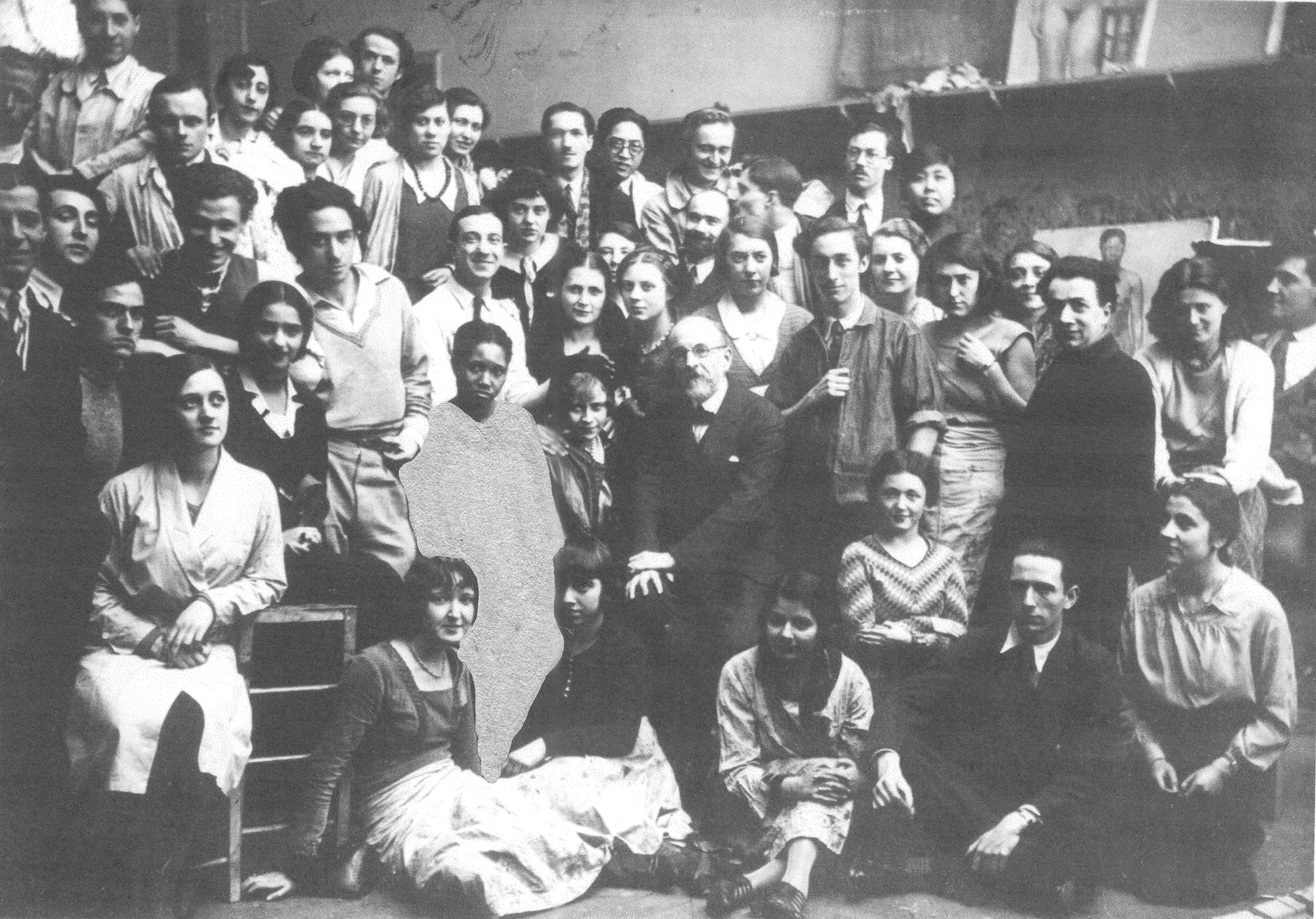
Lucien Simon's atelier. Image altered by the author. |
A Nickolas Muray 3-colour carbro portrait of actress Marlene Dietrich. Dietrich is in front of a Paul Gauguin painting in a white dress with ornate golden belt. She is striking a similar pose as the native subject of Gauguin's painting.
Paul Gauguin made a copy of Manet’s Olympia in 1891, to study it, probably in preparation for his own “Olympia”, the well-known painting The Spirit of the Dead Watches (1892), depicting Teha'amana, a Tahitian that was 13 when she met Gauguin (and not much later married him). This copy was also presented in the Musée d’Orsay’s exhibition, alongside many other Olympia variations. This might be a good segue to tell you about a photograph I found online of actor Marlene Dietrich in front of a Gauguin painting. This portrait belongs to the Smithsonian collection, and was taken by Nickolas Muray, a Hungarian-American photographer known for his colourful portraits and connection to artist Frida Kahlo. Here, the white woman stands dressed in a white glamorous gown in front of the painting of a naked woman of colour. We know the name of the famous white woman born in Berlin, known not only for her films but for being politically vocal against the Nazis, and defying conventions when it comes to what women are suppose to wear. In her case and in her time, suits and trousers, or should we say male clothes, “unsuitable” for women. I tried to find out who was the model in Gauguin’s painting. But I didn’t even find evidence of this painting actually being by Gauguin, as I couldn’t find it in the catalogue raisonné of his paintings or in any of the books I carefully browsed. So, maybe this isn’t a Gauguin painting after all, but one à la manière of the famous painter. Revising Gaugin’s legacy today is divisive. Problems concerning the age of his subjects (I prefer not to use the word muse, it implies stillness and being in service of the master) and the way he colonised them. Still, Gauguin remains an interesting subject himself, as historian Norma Broude’s book Gauguin’s Challenge argues. The chapter “Flora Tristan’s Grandson: Reconsidering the Feminist Critique of Paul Gauguin” reveals a little known fact to the general public: Gauguin was the grandson of Flora Tristan, a 19th century socialist and activist writer who made a substantial contribution to the development of feminist theory and women’s rights. Gauguin never met his grandmother, but mentioned her in his writings and Broude reflected on her influence on her grandson’s life in her book.
This picture seemed to frame perfectly all my worries of being a white feminist – a white blonde woman in a white dress with golden belt in front of the invisible generic woman of colour, bare-chested and nameless. The white woman, dressed to please the male gaze, impeccable in terms of society’s demands, actually more than that, because she was a superstar. I took a deep breath and thought about how this white woman was defying stereotypes with her clothes and sexuality, and her stance against the Nazis, but kept on wishing I could add an extra layer of intersectionality to her, like I was trying to do myself. But that was not the time. That was 1946, the Second World War had just ended. But today, at present, what do you see white woman? Take yourself back and dismantle settled notions. Is everything all right around you? Question your behaviour. Question what you are not considering. Turn yourself around and face the painting and not the photographer taking your picture. Ask her for her name.
The image of women of colour perpetuated throughout my youth defined the attention I gave them, they were barely around me, they seemed far away, hidden. I mistreated none but was ignorant about how they were mistreated, their invisibility and suffering. Left at the margins they rarely would reach higher education, and faced racism accessing proper health treatment. Still today, in Portugal children of colour are put in the back of the class, and mostly dismissed, their expectations of further education erased. In my early teens, I would sing, “My baby don’t care for shows,” but I was only familiar with its cute stop motion video and knew nothing of the civil rights warrior woman who wrote it and sang it. I didn’t know the lyrics for Work Song.
In the 1980s, in Lisbon as a child, I was frequently sent to the supermarket by my parents. On our street there was a corner building, seemingly uninhabited and in bad shape that I had to pass by. One day there was a lady sitting outside in the front of the building, on a small bench, in what seemed to be a moment out of necessity and not leisure. My heart raced as I passed her because she was shaking, holding on to her purse. Moreover, she had covered herself completely with some sort of shawl or blanket. I couldn’t see her face, as her upper body was fully covered. She was sobbing under the blanket. Her hands I could see, holding on to her purse. She seemed to be at that moment taking herself out of this vicious world, she was seen and not seen, hidden. I had no idea what to do and was too young to ask if she needed help. If you get reduced to less of a human being and people treat you horribly and violently, how do you rise? I have now learned that historically black women have always risen, grouped and organised by themselves, for their children, for their human rights. They have earned with every drop of blood, all that they are. Writing this doesn’t imply or diminish any other person’s suffering. But it does put things in perspective. Rather, if we concentrate our attention on society’s oppressed groups, we will all rise together. I have learned this by reading black women. One will take you to another. “What black feminists promised all along was true: to know the most present marginalized oppressions is to know the future.” Tressie McMillan Cottom said.
When writing about her connection to art at an early age within her family and being confronted with images of black women’s bodies, bell hooks told us that “Long before Paul Gauguin’s images of big-boned naked brown women found a place in my visual universe, I had been taught to hold such images close, to look at art and think about it, to keep art on my mind.”
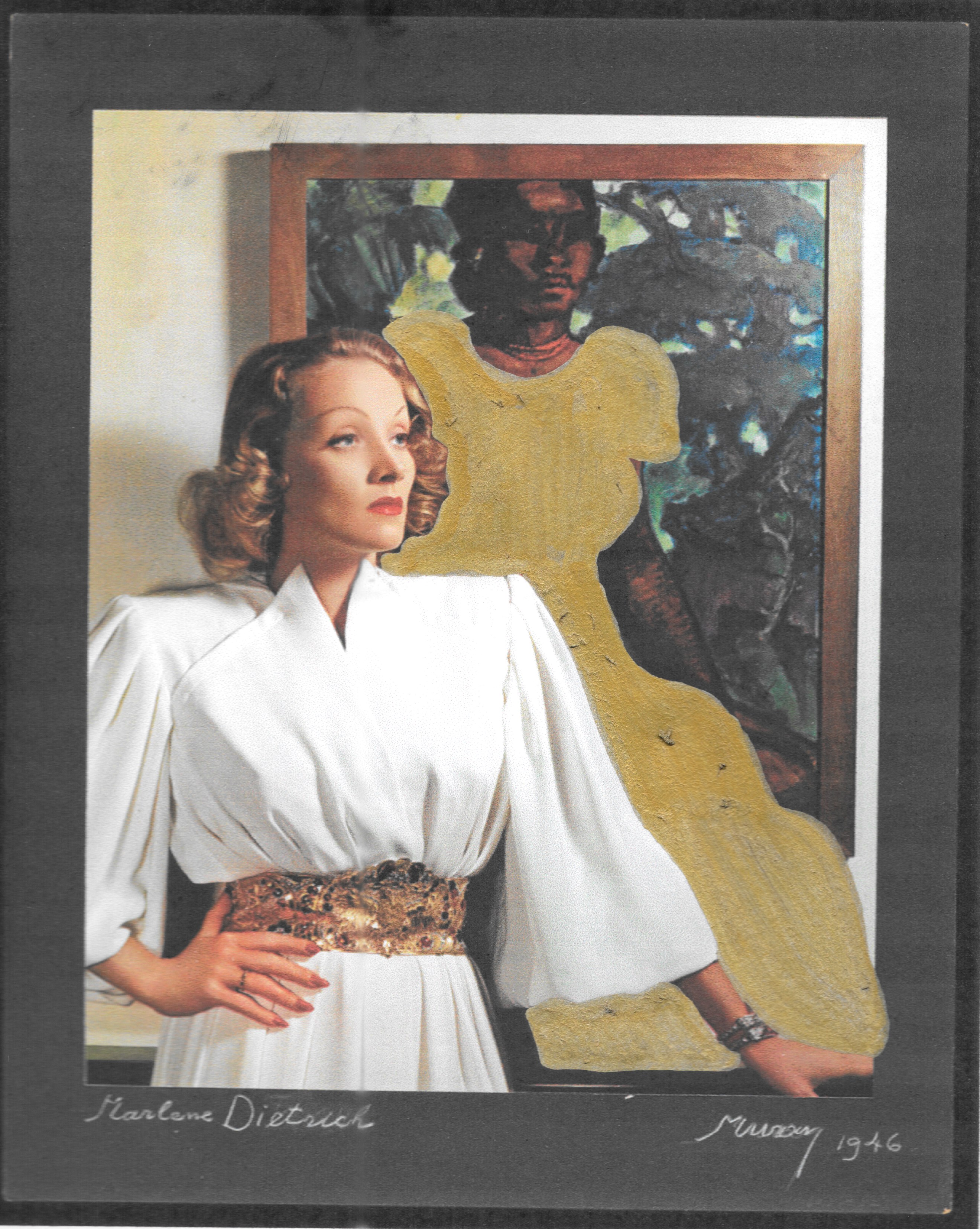 Nickolas
Muray portrait of Marlene Dietrich. Image altered by the author.
Nickolas
Muray portrait of Marlene Dietrich. Image altered by the author.[Union Station is the frontier between NE and NW. H street is at the back of the station, elevated, in a sort of viaduct over the train tracks and surrounded by TV networks, some federal buildings, and a healthcare company, Kaiser Permanente, that always made me grin. “Permanente” is the Portuguese word for permanent. The health company was named after Permanente Creek, a word with Spanish origins, hence the proximity with the Portuguese language. But before 1907, the date the station was erected, around this area there was Swampoodle, a working class neighbourhood, first populated by Irish immigrants and African Americans who built the city, more precisely, their hands made the White House, the Capitol and other surrounding buildings all completed in the 1800s. Swampoodle was a name allegedly given by a reporter because of its puddles and numerous swamps, created by the overflowing of Tiber Creek (a tributary of the Potomac River).]
PART II
Public Journal Entry [A Possible Bond]
“What did it mean for a black woman to be an artist in our grandmothers’ time? In our great-grandmothers’ day? It is a question with an answer cruel enough to stop the blood. (…) The agony of the lives of women who might have been Poets, Novelists, Essayists, and Short-Story Writers (over a period of centuries), who died with their real gifts stifled within them.”
— “In Search of Our Mothers’ Gardens”, Alice Walker (1983)
“We welcome all women who can meet us, face to face, beyond objectification and beyond guilt”
— “The Uses of Anger”, Audre Lorde (1981)
All this walking around in DC had some physical consequences. Like a blister the size of a pocket round mirror on the sole of my right foot. The sole, not the ankle, not the side, the sole, did you hear me, the soul. I still have a picture of it on my phone, before bursting it and removing the skin. I sent the picture to my niece, who was in medical school at the time. She told me to get a needle and some thread and place the thread across the blister. The thread would suck up the liquid and would help it dry. By the time her advice reached me I had already thrown my own skin in the trash and disinfected the whole thing in the hope I could still walk the next day. Her advice came not from medical school but from real experience – in her early twenties she already had under her belt not one but two prolonged journeys on foot from Lisbon to the Catholic Sanctuary of Fátima (127 Kms/79 miles), an actual pilgrimage site in Portugal. I was able to walk the next day. I carried on.
It will be upsetting sometimes, you will feel discomfort. A small pebble might find a home in your boot. You will make mistakes. There will be a lot of negative replies. A lot of silence. I don’t believe that in practical terms you can have “no expectations” about your endeavours and wishes, because our capacity to dream should not be diminished. But we should add a realistic view of what can happen or what small things can be accomplished. Just consider the path, you will stumble but you will also trot with confidence. When that happens, trot with joy. “Joy is made to be a crumb” (Mary Oliver).
This can take years. This walk towards a greater knowledge of history, of social injustice, of gathering solutions within what you do, your profession, in a way that you can be closer to being an ally. You cannot be an ally without being highly informed. You cannot be an ally until someone with authority to do so nominates you as such. You might think this is all a big exaggeration of mine, but fellow white women in the arts, those opinions and set beliefs you have had for years, where do they come from? Go to the root of it and dismantle it. Are they based in real study or on your surroundings and their limitations?
I should clear something up, I am not an activist. I will not abdicate working in the arts for true selfless work, driving non-profit organisations to fight real blood and sweat fights. An activist is someone who devotes the majority of their lives to causes. I don’t. I am only trying to apply change and justice to the path I have chosen. To my gender, to people of colour, to oppressed minorities. Considering a lot at the same time with some priorities, but checking myself and my actions and their consequences along the way. In order to perfect and inform what will end up being taken as my instinct and my capacities as a curator, an arts worker, but more importantly as a human.
British Museum at Yale, May 1978. 1 photograph: colour transparency; 35mm (slide format). Call Number: LC-GB05- 7056 [P&P]. Library of Congress, Prints & Photographs Division, photograph by Bernard Gotfryd, [Reproduction number e.g., LC-USZ62-123456].
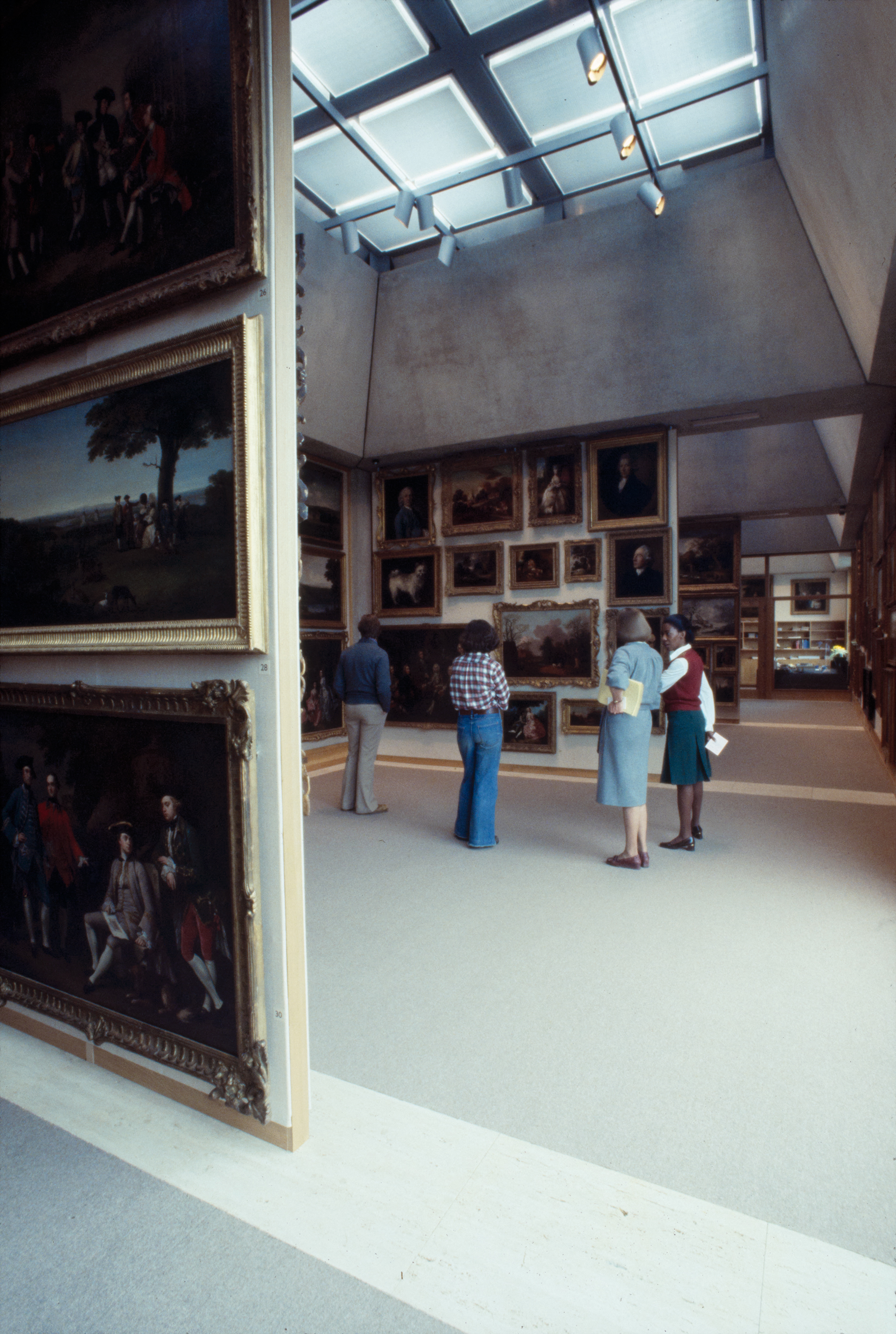
| British Museum at Yale, photograph by Bernard Gotfryd. |
This photograph titled British Museum at Yale (now the Yale Center for British Art) is by Bernard Gotfryd, a photographer that survived six different concentration camps, immigrated to the US, worked as a combat photographer and later worked for over thirty years at Newsweek. In 1990, he released the book, Anton the Dove Fancier and Other Tales of the Holocaust, a project that was born after photographing fellow Holocaust survivors at the White House, followed by a trip back to Poland for the first time after the Second World War.
Gotfryd must have been sent by Newsweek to cover the museum in New Haven, Connecticut, founded by Paul Mellon, an art collector and philanthropist passionate about British art. The modernist building designed by architect Louis I. Kahn (his last building) had opened some months earlier in April 1977. The set of several photographs taken as indicated in May 1978, inside the museum, of which I have chosen one, seem to be of those couple of days just before the opening of a major exhibition perhaps. One shows a work table in the exhibition room, something temporary it seems, with some registers, others when seen together show what clearly seems like museum staff serving as human scale for the photograph. The same people placed in different positions around the exhibition rooms either observing paintings or engaging with each other on a sofa. No one has a handbag, or any kind of bag or coat. It seems the show was not opened to the public yet, so they were there simulating being viewers of the art works for the purpose of the picture.
In four different photographs, I recognised what seems to be the same black woman dressed in a white shirt, burgundy vest and green skirt. In the picture I chose, she is engaging with a white woman who is holding some folders with her left arm. The black woman also holds a small card. By what they are wearing, their interaction and my own visual dictionary, informed by good and bad social judgements and prejudice, they seem to work together and I would be inclined to say the white woman is probably a curator, and the black woman seems to be a gallery assistant. In the other pictures she is on her own, active, present and engaged through the exhibition rooms.
Playwright Lorraine Hansberry was a radical writer and activist, the first black woman to ever have a play produced on Broadway: Raisin in the Sun. I particularly love this ending to a letter she wrote to her boyfriend, showing her determination in the form of a manifesto:
“1. I am a writer. I am going to write.
2. I am going to become a writer.
3. Any real contribution I can make to the movement can only be the result of a disciplined life. I am going to institute discipline in my life.
4. I can paint. I am going to paint.
The END"
She spoke with the same determination when referring to teenage winners of a writing contest: “To be Young, Gifted and Black”. This sentence inspired Nina Simone, who knew the author but even so when she saw her picture in the New York Times was struck by Hansberry’s eyes, they were trying to tell her something. You can find this online, Simone explaining that photography has its own way of communicating and that it got hold of her, so much so that she wrote a song in her memory. The lyrics go, “to be young, gifted and black / is where it's at” (lyrics by Weldon Irvine).
Black female artists and essayists have been reclaiming their creativity and the imagery connected to their bodies. bell hooks writes about Lorna Simpsons’ Waterbearer, a photograph showing a black woman with a jar of water in each hand as reminiscent of Vermeer’s paintings of working women, but highlights the woman’s “defiant stance” – “by turning her back on those who cannot hear her subjugated knowledge speak, she creates by her own gaze an alternative space where she is both self-defining and self-determining.” hooks points out that Simpson demands that we take a deeper dive and that she aims to “rescue and recover” black female bodies, because the mainstream doesn’t depict the real depth of black women. That a black woman “is not herself but always what someone else wants her to be”. The naked woman in the sea of fully dressed people, the women in Gaugin’s paintings, the woman that hid herself underneath a blanket, the woman inside the museum.
This reclaiming by black woman artists is important to be witnessed, as spectators, as thinkers, as white women. Only then do we white women curators have the chance to understand/connect with work made by black artists. Do you know enough of other cultures to exercise the right to criticise or review their artwork? Which parameters are you using? Aren’t your western contemporary art parameters too white and inadequate? Have you considered that you have to stretch what you think is your taste in order to engage with art works from people of colour? Do you know enough about your own white race? It established oppression with other races, and devised the concept of race itself, so does that give you a hint not to turn defensive the minute something happens? Do you really think the white race needs “defending”? It is important for white women curators and researchers, that have difficulty even for a second in giving up their skin privilege in order to become allies, to read and understand the black female experience, and its clear differences. That will put things in perspective.
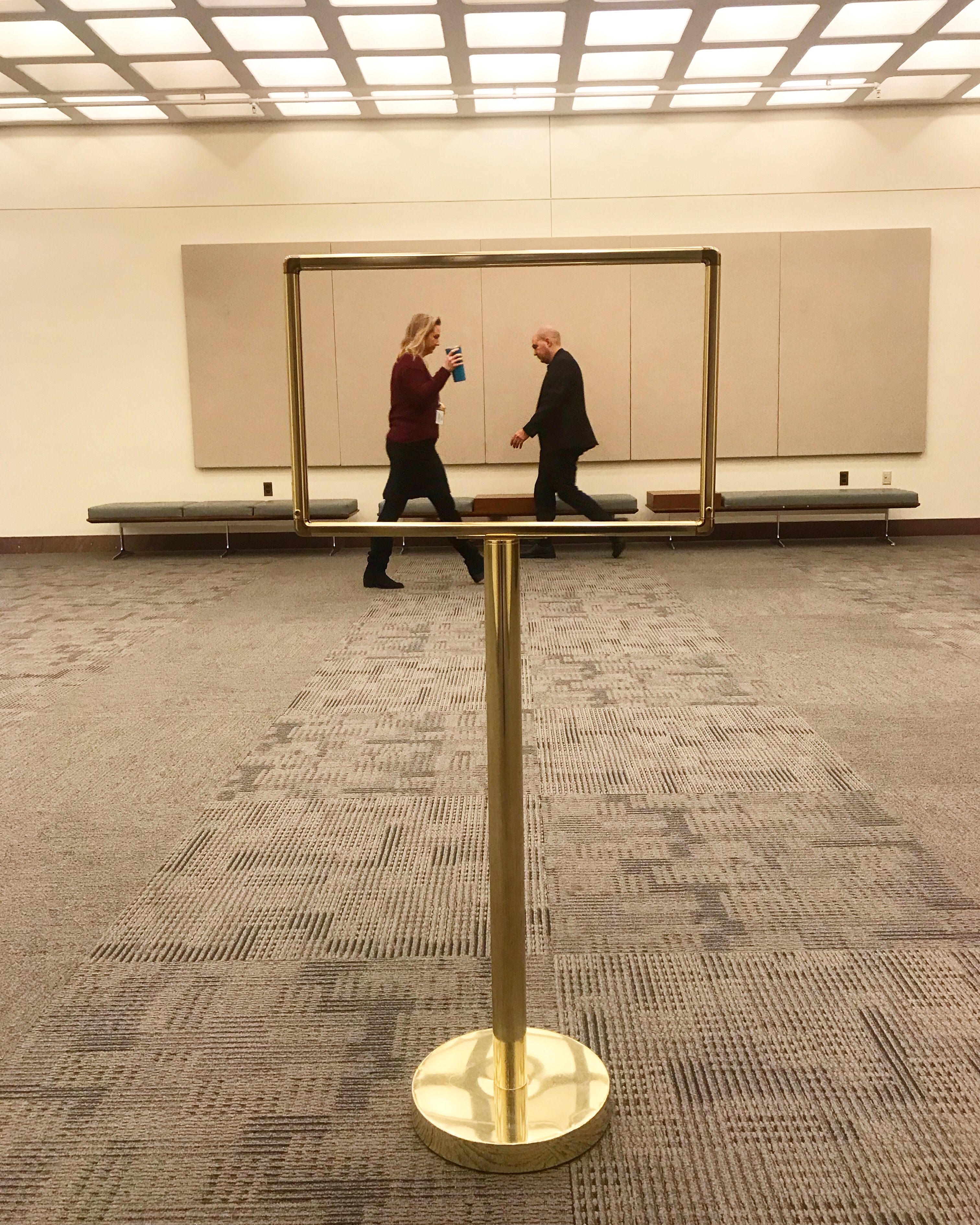 At the Library of Congress. Photograph by the author.
So, what does a white woman curator need to know? There is work to be done. Because art is also about justice, as Paley argues, it’s “the illumination of what isn’t known, the lighting up of what is under a rock, of what has been hidden”. But making minorities visible, dear Portuguese white woman curator, is not just “selecting” that one black woman artist, it is not just making that list of artists a little more equal in terms of gender, it is not just acting as a token woman, remaining exactly in the same position and going about as usual, specially if you are in a position of power. It is not just artists, but art writers, producers and curators of colour, a whole community that has to grow and rise to visibility. From margin to centre – I learned this from Grada Kilomba who learned it from bell hooks. This artistic production has to be reflected by specialists of the same culture. Also, there are archives to be made. There are young girls of colour who need to have every option available. They have to know, they can be an artist. There is justice to be applied. There is restructuring to be made. When you open the door to one black woman, do not think you are doing “good,” do not highlight the opening of the door, it is not enough. Do not gloat over your small action. A white woman curator needs to know that in this process her own notion of “taste” should be reassessed. She should realise that probably her parameters are limited by Western culture, and therefore are insufficient to critique other cultures. In the process of learning, an expansion of taste is bound to happen. But give it time. There is a whole world to consider, a whole Global South to open our eyes to. Whole relationships to be built and trust to be earned by both parties.
Museums in Washington DC were my place of rest from walking. There were so many of them. I joke, I love museums and what they do to my spirit, of course, in many fulfilling ways. In practical terms, they were always the final objective of my walk. The end game. The visual learning or unlearning, the worlds that opened up, the knowledge I instinctively held within me. Those Kara Walker drawings, the Alma Thomas paintings, that Kerry James Marshall painting of a girl sobbing in her library, that Kennedy portrait by Elaine de Kooning, that audience member looking at that person in Amy Sherald’s painting, that portrait of Diane Arbus holding one of her own photographs, that daguerreotype of a man c.1855 behind a newspaper covering his face, that Yoko Ono sentence written on a wall: “Relax. Your Heart is Stronger Than You Think!”. I kept on walking inside their walls, reaching every floor, every corner, every majestic room. I cherished those buildings but nevertheless questioned the reasons, their origins, their very existence. For certain, there were empty exhibit cases inside rooms I was not allowed to go into. Those can, and should, symbolise restructuring. Their glass might be dirty or clean, dust might be stuck in those wooden joints. Should new ones be built, should these cases be kept? All is still open while our lives run, while you slide the glass, or let it drop gently, to close it. You might be wearing white gloves. These exhibit cases will carry a myriad of different objects in different configurations, but all content will leave a mark.
I am no longer walking in DC, I have crossed the ocean back, but still feel suspended in desire, belief and future. This constant search, curiosity and thirst to learn sets what seems to be an unstable life. This instability should mostly be read as excitement. Would I be able to feel alive any other way? As long as we’re living there is no clear finish line, so I just want to keep walking beside you. One minute I might stop, another I might walk faster, you might do any of these variations. We might look each other in the eye, we might turn our backs for a while, but here we are, close, able to help each other out, at arm’s length. One day soon, I hope, profiting mostly from the same benefits and battling the same injustices. One day soon, I hope.
Gwendolyn Brooks, poet extraordinaire, has her name on several plaques I suspect, rightly so. Later in life, she wrote a poem for the unveiling of a sculpture of her own face, a homage, both sculpture and poem. She read it at a public event. Here are the last lines: “no longer walking through rooms, I shall be gone and not gone”.
Susana Pomba
Círculo das Leitoras Peripatéticas

Círculo das Leitoras Peripatéticas: Galeria Municipal do Porto, Junho 2021
Círculo das Leitoras Peripatéticas [Circle of Peripatetic Readers] is a project by Susana Gaudêncio, Sofia Gonçalves & Susana Pomba. What follows is my contribution to the project in Porto, at the Concha Acústica in the Gardens of Palácio de Cristal/Galeria Municipal do Porto. Each one of the members of the group read her text in a structure of 4 acts. Translation to EN, soon
Acto I
Não é preciso ser muito aventureira, podemos medir riscos, calcular estratégias, mas indispensável é o impulso de dar à arma e iniciar a marcha. Que deve ser sempre marcada por ruído forte. O aviso de começo de corrida. Teme-se algo à distância, reage-se com os músculos das pernas, vamos de encontro ao perigo. Este é o primeiro ato, acabámos de passar os portões de ferro, abertos em jeito de recepção.
Vamos ler o espaço a andar. Iniciar a marcha, quase sempre decisiva, por vezes desnorteada. De armas e bagagens. Já não víamos as quatro estações ao vivo com plintos sustentando alvos, há tanto tempo. As pernas estão torpes, os músculos atrofiados, os braços fracos. Os pensamentos desviam-se muitas vezes para o interior dos músculos quando estes se esticam e reagem, como num baile no meio da pista onde os tendões se surpreendem pelos movimentos que não sabiam poder fazer, ao som de “Ricochet”, espasmos. Mas por enquanto, a música é o som da gravilha espremida por baixo das solas dos sapatos.
Não passeamos só por prazer, temos objetivos, importantes assuntos a descobrir e a discutir. Temos coisas que se começam a revelar que tememos ao longe, lutas a encetar, mistérios a reagir e a revelar. Temos, plural, porque não estou sozinha, não estamos sozinhas. Encontramo-nos em determinados pontos do caminho, caminhamos juntas em sentido figurado. Registem esta afirmação, porque vou alternar entre o nós universal feminino e a primeira pessoa, feminina.
“Se uma narrativa é a sequência de eventos, então estes jardins de esculturas fizeram do mundo um livro, por situarem estes eventos no espaço real, suficientemente separados para serem ‘lidos’ ao andar (...).” Esta frase é da escritora, historiadora e ativista americana, Rebecca Solnit.
Na língua inglesa existe a expressão, “A Walk in the Park”, para exprimir algo que é fácil e prazeroso. Vamos colocar a anteceder essa expressão, as palavras “não é”. Prever o pior para receber o menos mal. Não é um belo passeio no parque, até já consigo cheirar a pólvora.

Começa a batalha contra as representações desnudas da Primavera/Verão, Outono/Inverno, estações de drapeados e tendências de panejamentos. Os primeiros tiros são realizados com um mosquete do século XVI. Sim, uma arma bastante antiga para este século XIX mas, desgraça, era o que tinha à mão. De qualquer maneira, um belíssimo exemplar de uma das primeiras armas de fogo. Coloquem-se os dedos corretos nos orifícios certos da dita arma. Pelo mosquete sai pequena referência à grande ANNA ATKINS. Uma figura pivotal do século XIX, que nasceu no Reino Unido no finzinho do século XVIII e esteve na terra até 1871 (supomos que quando morreu não haviam armas por perto), foi botânica, um interesse “permitido” às mulheres nessa época. E de repente li esta frase assim nas minhas pesquisas: “Anna Atkins é considerada a primeira mulher a praticar a fotografia”. Sim, eu sei, se calhar precisamos de uns segundos para receber esta informação [pausa]. Mas há mais. Atkins, botânica, fotógrafa, fazia publicações e foi a primeira a ilustrar um livro com imagens fotográficas [outra pausa]. Claro, que teve que fazer o dito livro à mão em casa, prova a prova, mas ainda existem cerca de 15 cópias completas e mais umas incompletas. “Fotografias de algas britânicas: impressões em cianótipo” (1843-1853) está na coleção do Met, em Nova Iorque, e utiliza imagens com a técnica fotográfica de Atkins (sim, porque é inescapável, esta técnica é dela)—Cianótipo, um processo de impressão fotográfica em tons azuis. Era através destas imagens que AA (botânica anónima) representava os seus objetos de estudo, neste caso algas. Uma perfeita comunhão entre ciência e arte. O pai Atkins trabalhava no British Museum, e porque Anna perdeu a mãe em tenra idade, a relação com o seu pai era forte, e por isso ela pôde ter acesso a muito mais conhecimento, que não era comum ser dado a raparigas. Ali pelos 20 anos, Atkins desenhou 256 reproduções cientificamente corretas de conchas, que foram publicadas no catálogo traduzido pelo pai, “Genera of Shells” (1822-24) de Jean Baptiste de Lamarck. Conchas. Muito mais tarde, pelos 40 anos, foi-lhe dada uma máquina fotográfica, mas essas imagens não chegaram até nós.

“Genera of Shells” (1822-24)

Cianótipo de Anna Atkins
ACTO II
Largámos o mosquete, como se nos livrássemos da raiva da injustiça de um valor e reconhecimento que é devido, e para além de não dado é de forma consciente retirado. O mosquete ainda rodopiou no chão indicando a direção da avenida das delicadas tílias e do rio. Mistura-se o cheiro, fumete ou fumito do fogo, com a flora circundante. Não há pólvora que chegue para isto tudo. Não há chá de tília que nos acalme. Mas há frutas e usufrutos, esperemos por elas.
Estamos no século XX, M. S. POMBA GUERRA nascida em 1906 (o mundo levou-a em 1976), foi farmacêutica, escritora, jornalista, tradutora, professora, ativista antifascista e anticolonialista que muito fez em backstage pelos movimentos de libertação das antigas colónias. Tanto que até foi a primeira mulher branca a ser presa pela PIDE em 1949 (eu preciso agora aqui de uma pausa, ela esteve na prisão de Caxias até 1950, durante sensivelmente 6 meses). Para além de todas essas atividades e mais outras, enviava durante os anos 1930 estudos sobre os frutos de Moçambique, para a sua antiga faculdade, a Universidade de Coimbra. Estes estudos eram publicados em boletins, intitulados “Moçambique—Documentários Trimestrais”, a palavra usada era mesmo esta, “documentários”, publicados depois em Lourenço Marques, ou seja, Maputo.

Maria Sofia Pomba Guerra
Para este trecho de M. S. Pomba Guerra podemos nos sentar num dos bancos da avenida, pernas esticadas, braços esticados alongados acompanhando a parte superior do banco, músculos estendidos em tensão, cabeça com ligeira inclinação ao céu. Esta é a introdução de um desses estudos de Pomba Guerra, vou começar, preparem-se: “Nos dias cálidos, de quietação sufocante ou fustigados de esbraseantes rajadas, quando tôda a vontade de acção se esvaece num deixar-correr de indiferença, a polpa sumarenta dos frutos, gelada, envolvendo os mais requintados aromas, é ainda supremo deleite. (...) É inigualável o creme alaranjado, túrgido de sumo doce e perfumado, duma boa manga bem madura, duma papaia ou mesmo ainda da pobre banana, tão desdenhada aqui na sua modéstia ao lado das frutas caras de importação. Se não fôsse a velha verdade de que ninguém é rei na sua terra ou de que a abundância conduz à saciedade e ao desprêzo, nunca a banana se veria relegada para plano de fundo, como fruta de estima, na luta com rivais por vezes bem menos valiosas.”
Saco agora de um bacamarte, arma do século XIX de grande calibre e cano curto mas largo, e dirijo a ponta ao céu, apanho tílias que descendem, apanho pássaros que se escapam num único movimento sincronizado de fuga, brusco, pelas copas das árvores. Com os músculos do braço bem doridos ainda tenho tempo de pensar que M.S. Pomba Guerra assinava assim os boletins talvez para que se assumisse que se tratava de algum homem a escrever, e que por isso em pensamento automático a sua escrita seria levada mais a sério do que se tivesse assinado Maria Sofia Pomba Guerra.
Era a minha tia-avó que nunca conheci mas que aqui presto homenagem e agradeço a emancipação de que hoje tenho usufruto, e como exemplo, este momento exato que assino com nome próprio e último, Susana Pomba. Outra curiosidade, Sofia, que quer dizer conhecimento, era casada com Platão, que dispensa apresentações filosóficas, e acumulou para além disso a mais fantástica combinação de últimos nomes: Pomba, símbolo de paz, e Guerra, o seu exato contrário. E em festejo e homenagem deste e de todos os outros factos, uma salvé à minha tia-avó! Mulher de ciência, letras e lutas! E aqui seguem mais uns tiros de bacamarte para o céu, e mais uma fuga veloz das Pombas à Liberdade.
ACTO III
Não sei desde quando, mas colaram à natureza o género feminino: é a “mãe-natureza”, a “mãe-terra”. Foi emparedada com a fertilidade, símbolo de nascimento, de dar vida e por aí fora. Qual Botticelli, qual nascimento de Vénus, qual Uma Thurman no meio da concha. Pensem na quantidade de corpos de mulheres desnudas que andam por aí pelos jardins de esculturas. Não são monumentos à mulher, são apenas uma visão masculina, na verdade minimizadora, que coloca as mulheres no papel reprodutor, no papel de dar beleza nua e jorrar água, no papel decorativo, no papel secundário. Nós humanos somos muito mais do que isso. P.S. Para tempos futuros, que na verdade são já agora a seguir a isto. Temos de nos deixar de comportar como centro do universo. P.S. 2 Esta versão binária homem/mulher é limitadora e não-abrangente. P.S. 3 Apontar ao ecofeminismo. P.S. 4 Tenho de referir Gruta, desculpem, Greta Thunberg e a citação, “Our relationship with nature is broken. But relationships can change”.
Carabina de caça Browning 270, são necessários uns exercícios para estender os músculos do braço direito. A partida para o Lago dos Cavalinhos é assinalada com dois tiros certeiros (não se sabe bem em quê). O lago tem esculturas intituladas “Amazonas a cavalo”—as frutas que essas mulheres nuas carregam jorram-lhes água pelo corpo. O lago é rasteiro, pouco fundo. No final dos anos 1960, a artista japonesa YAYOI KUSAMA (nascida em 1929), uma verdadeira mulher-guerreira, chegou de cavalo branco e pintou a água com bolas vermelhas, cobriu um homem de folhas e plantou-o na terra como se fosse uma semente. Esta descrição é do seu filme experimental de 1967, “Kusama’s Self-Obliteration”. A natureza é o coração do trabalho de Yayoi Kusama, que cresceu rodeada de estufas (o negócio dos pais), campos e ciclos de vida e de morte. As suas memórias são de total imersão num mundo de plantas e flores, que muitas vezes tomavam vida e falavam com ela. Kusama é hoje finalmente a artista blockbuster que merece ser: durante esta primeira metade do ano que corre inauguraram, mais de 3 exposições com o seu trabalho, em cidades como Nova Iorque, Berlin, ou Washington DC. Ela foi pioneira no minimalismo, na performance arte, nos happenings, na pop arte e nas grandes instalações “imersivas”. Isto é excecional nos dias que correm, a arte feita por esta mulher faz as pessoas fazerem filas de horas e horas que dão volta ao quarteirão, para entrarem nos seus “Infinity Rooms”.

“Grand Orgy to Awaken the Dead” (1969)
Kusama incorporou na sua arte, antes de toda a gente, o “publicitar”, a “promoção” (Andy Warhol anyone?) e parte disso estava uma série de happenings que fazia à revelia, sem aviso ou convite. Num dia prazeroso, Kusama e a sua pandilha hippie com corpos pintados com bolinhas entraram pelo MOMA a dentro sem avisar nem pedir licença (o MOMA é só o Museu de Arte Moderna em Nova Iorque), dirigiram-se ao jardim das esculturas (a outro, não este), tiraram a roupa e enfiaram-se no lago e começaram em sessão de making out (esta é uma maneira soft de dizer, imaginem coisas mais extensas), marmelada em cima de uma escultura de bronze. Que representava a escultura? Uma mulher nua! Claro. E de repente a visão de quem se passeava pelo jardim era a de homens e mulheres nus em cima da mulher nua que adornava o pequeno lago do museu. Segundo consta, a artista fez “Grand Orgy to Awaken the Dead” (1969), para protestar a atenção desmesurada que o museu dava aos artistas mortos. Para promover o evento, Kusama escreveu, “no museu podemos tirar a roupa em boa companhia: Renoir, Maillol, Giacometti, Picasso” A polícia apareceu, a orgia terminou. E com mais uns tiros de carabina, os artistas homens brancos acordaram, atarantados, mas logo voltaram ao sono da sua glória em vida e em morte.
ACTO IV
A história da minha tia-avó anticolonialista e antifascista que nunca conheci não retira de mim a responsabilidade. Não deixo de carregar comigo a nossa história, a nossa história colonialista, como todas já referimos hoje, como todas nós carregamos. Nas palavras de James Baldwin: “A grande força da história vem do facto que a carregamos dentro de nós, somos de muitas maneiras controlados inconscientemente por ela, e a história está presente literalmente em tudo o que fazemos”.
Agora é o pescoço que se vira, esticando-se, dando voltas de 180º em círculo e levando depois os olhos em direção ao palco-coreto. E aqui chegámos. Porque deixámos este lugar para último? Queremos saborear, como se não tivéssemos estado aqui o tempo todo, neste espaço em granito que escolhemos, ladeado por figuras “exóticas” (a palavra é perigosa, eu sei). Andámos pelo jardim, não estivemos aqui o tempo inteiro. Estivemos aqui o tempo em partes. E estas figuras, são femininas claro, cada uma ladeando o palco, uma negra e uma egípcia. Construído talvez no início da década 1880, este coreto em forma de concha tinha uma pintura mural, do tipo “a tentar enganar o olho”, aqui vou abrir aspas, “que faz lembrar o interior de um salão de baile e deixa imaginar os inúmeros concertos e espetáculos que fizeram rir e chorar muitas gerações”, fecha aspas. Vou abrir outra vez as aspas, “Embora não com a frequência de outros tempos, a concha acústica ainda hoje acolhe concertos e pequenos espetáculos teatrais”, fechar aspas. Temo que nós a três não somos e não estamos a fazer, nem um nem outro. Estamos algures nos interstícios dessas definições.
O que estamos a ouvir, este som do mar, o som destas ondas que se partem aos nossos pés, são para a artista americana KARA WALKER, nascida em 1969, e por causa da sua Fons Americanus, que esteve no Turbine Hall da Tate Modern em Londres até há pouco tempo. A água é um elemento crucial da instalação, para falar do comércio transatlântico de escravos, para falar da história que carregamos. A fonte pública que construiu dentro da Tate faz referência aos grandes monumentos e memoriais, que não contam a história toda, que são monumentos ao poder colonial e que deixam de parte as pessoas escravizadas. Walker repõem essas histórias na sua fonte, e para começar, mal se descia a rampa do museu via-se uma concha, a que ela chamou de “Shell Grotto”, feita à imagem da tradição da história de arte, das ilustrações de Vénus, a deusa do amor na mitologia romana. A mulher branca, nua, centrada numa concha. Só que Walker colocou na concha um rapazinho quase totalmente emergido em água, a chorar, com água a jorrar do canto dos seus olhos em contínuo. Por todos os que contra a sua vontade foram colocados em barcos, por todos os que morreram no meio do oceano ou nas plantações. Walker, reclama para si a imagem da Vénus, na sua versão a Vénus negra (imagem usada como propaganda do comércio de escravos) foi colocada bem no topo da fonte, a jorrar água e ela é a filha das águas, nas palavras de Kara Walker: “The amniotic fluid at the beginning of this journey is now transformed into mother’s milk and lifeblood. Mother, whet nurse, whore, saint, Host, lover—she is the daughter of waters”.

Kara Walker. Courtesy of Tate Modern
Nos vários estados físicos da água já temos como nosso o líquido, e agora guardemos também todos os outros, e especificamente o gasoso. Para dar início ao baile final, um baile debaixo de água, de celebração, homenagem, e encantamento, vamos precisar de convocar toda a artilharia feminina. Um Enchantment Under the Sea com a decoração adequada, bebidas fumegantes e conchas decorativas que servem de fundo às fotografias que marcam o fim do curso. Este foi o interlúdio, e agora já não chegam armas de cano curto, vamos precisar mesmo de uma Bazuca. Isto é Beyond the Sea, isto é a vontade de encontrar oysters under the sea.
Maria da Conceição Batarda da Silva Granate, de nome artístico curto e doce, CONCHA, nascida em 1957, é um cantora portuguesa que foi membro da Banda do Casaco, e nos agraciou com alguns sucessos a solo, e esteve na final do Festival da Canção em 1979 ao lado de Gabriela Schaaf e Manuela Bravo. Esta última acabou por ganhar e nos representar nesse ano com “Sobe, sobe, balão sobe”.

Concha no Festival da Canção em 1979
A canção escolhida, destemida e cantada em sopro, é “Qualquer Dia Quem Diria”, e é uma ameaça todos os dias: que perde a calma, que perde a vergonha, que perde o juízo, que corta a trela, que parte as janelas, que perde a paciência, e no meio da rua para toda a gente ver. Apostamos que estamos em frente a uma vitrine que nos espelha e que apesar da canção parecer deixar em aberto o “quando”, “qualquer dia, hoje em dia, quem diria, qualquer dia, qualquer dia”, vamos de bazuca esclarecer aqui e agora, que este qualquer dia é hoje mesmo, vai ser agora mesmo que vamos colocar “o ponto final neste castigo”. Carreguem a bazuca, 3, 2, 1.
Susana Pomba
escrito para o Círculo das Leitoras Peripatéticas, evento na Galeria Municipal do Porto, Junho de 2021.

Evento do Círculo das Leitoras Peripatéticas na Concha Acústica nos Jardins/Galeria Municipal do Porto, Junho de 2021 (Foto: Renato Cruz Santos)

Evento do Círculo das Leitoras Peripatéticas na Concha Acústica nos Jardins/Galeria Municipal do Porto, Junho de 2021 (Foto: Renato Cruz Santos)

Evento do Círculo das Leitoras Peripatéticas (c/ Sofia Gonçalves & Susana Gaudêncio) na Concha Acústica nos Jardins/Galeria Municipal do Porto, Junho de 2021 (Foto: Renato Cruz Santos)

Evento do Círculo das Leitoras Peripatéticas na Concha Acústica nos Jardins/Galeria Municipal do Porto, Junho de 2021 (Foto: Renato Cruz Santos)